
This is that niggling little quiz on English spelling, the sort of question that can make even most confident writers second guess if they used the right word. This confusion arises because of the unusual spelling of “eye” and how English normally changes verbs in “-ing.”
Fortunately, rest assured the question is not just one where one approach is right and the other wrong, it is a little more interesting than that. Eyeing and eying are both accepted present participles of the verb to eye. Cambridge Dictionary has two spellings, plus the definition of the verb eye is to look at someone or something with interest.
But, eyeing is how most readers will be used to seeing it pinned down, making it an obvious and organic selection for both everyday and professional reading. This article will discuss eyeing or eying: Definitions, spelling patterns, usage in sentences, common errors and guides on the breakdown of when to use each form.
Eyeing or Eying: Quick Answer
If you are wondering whether to use eyeing or eying, both versions may be in English as well. They are synonymous with, and perform the same function as, the present participle of the verb eye.
The verb “eye” means to look at someone with interest or attention, oftentimes for a specific purpose. For example:
- She was eyeing the chocolate cake.
- She was eying the chocolate cake.
Both sentences convey the message that she was interested in looking at the cake.
Most of the time, for regular writing, eyeing is probably the more common spelling and will likely be the best option for readers. Also, eying should not automatically be considered a misspelling because dictionaries recognize it as an alternate form. So, “eyeing or eying” as a present participle in Cambridge, particularly.
| Form | Meaning | Usage |
| Eyeing | Looking at something with interest or attention | Common and familiar |
| Eying | Same basic meaning as eyeing | Recognized variant |
| Eye | Base verb | To look at with interest |
| Eyed | Past tense and past participle | Looked at with interest |
So, if you’re looking up eyeing or eying, remember that the two forms aren’t two different words.
What Does “Eyeing” Mean?
To understand a spelling, it is helpful to know what the word means.
Eyeing has to do with looking at a person, place, object or opportunity in a manner of interest. This can imply that they are watching something carefully rather than simply seeing it.
For example:
She was eyeing the new handbag in the store.
It implies that the handbag captured her attention, that she was gazing at it in the same way, a bit similar to how we obsess over bags.
Similarly:
He was eyeing the last piece of pizza.
In this sentence, “eyeing” indicates that he looked at the pizza because he wanted or thought about eating it.
The term can also be used in relatively nonliteral contexts. For example, someone could be “eyeing” a job, promotion, or business opportunity – a destination or goal. In these contexts, the term generally implies probing or contemplation rather than merely gazing.
Eyeing or Eying Used in Sentences
When you see the forms in context, understanding eying or eyeing is a lot simpler.
Here are some examples:
- She was eyeing the blue dress in the window.
- He kept eyeing the empty chair.
- The children were eyeing the birthday cake.
- I have been eyeing that phone for several weeks.
- The company is eyeing new markets.
- She was eying the dessert menu.
- He stood near the shelf, eying the books.
- They were eying an opportunity to expand their business.
- The dog was eyeing the food on the table.
- She is eyeing a promotion at work.
The word is used in every sentence to describe intentional attention, a sense of curiosity or being thought-provoking.
Also Read: Tries or Trys | Seal vs Seel | Girlie or Girly | Hussle vs Hustle
Why Is “Eyeing” Confusing?
The mix-up between eyeing and eying comes mainly from common spelling conventions in English.
The final “e” is often lost in words (verbs) and sentences in which it must be pronounced, so long as that “e” is a silent one.
For example:
- make → making
- take → taking
- write → writing
- bake → baking
- hope → hoping
Because “eye” ends with the letter “e,” it may seem logical to remove the final letter and write “eying.”
That produces:
eye + ing = eying
That seems utterly fine from the point of view of spelling rules. There are a lot of words that do not behave exactly how the learners would expect in English. For example, eye has two different valid forms: eyeing and eying.
Spelling eyeing links to the original word “eye”. That makes it a little easier for many readers to see.
Eyeing vs. Eying: Is There a Difference in Meaning?
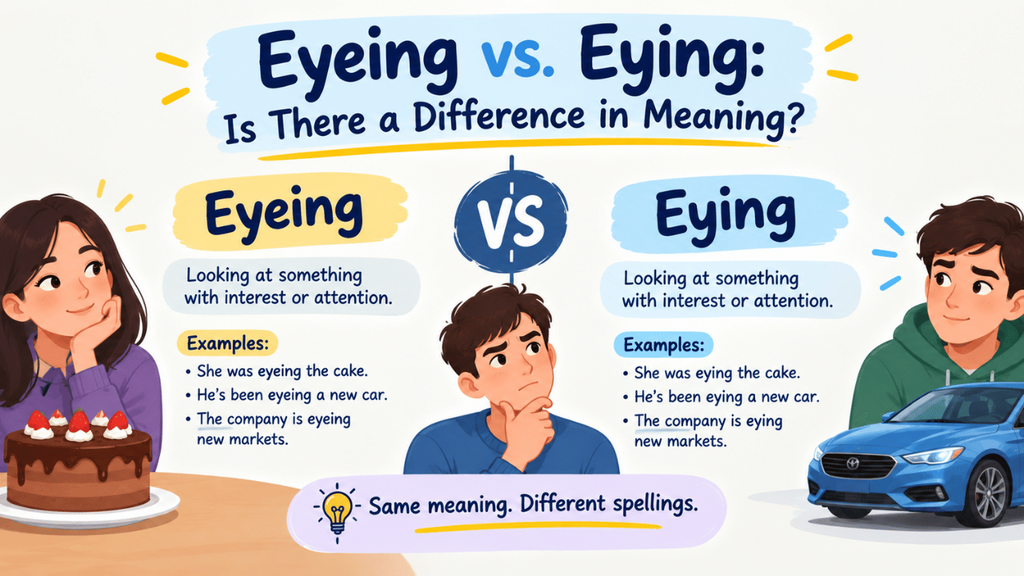
There is hardly a difference in meaning between eyeing or eying.
Both forms are utilized for the present participle of “eye. According to the Cambridge dictionary, one definition of this verb is looked at someone or something with an interest and it has eyeing and eying as present participles.
Consider these two sentences:
Maya was eyeing the new laptop.
Maya was eying the new laptop.
The net result is about the same: Maya was intrigued by the laptop.
There is more difference in spelling and familiarity than in meaning.
| Sentence | Meaning |
| She was eyeing the cake. | She was looking at the cake with interest. |
| She was eying the cake. | Same meaning. |
| He was eyeing the car. | He was looking at the car with interest. |
| He was eying the car. | Same meaning. |
This is significant because some complementary explanations of eyeing or eying – in light of its grammatical status compared with eyeing – wrongly have the two forms out to seem as if they are viewed as distinct in their grammatical status.
When Should You Use “Eyeing”?
Eyeing is instantly recognizable, so it lends itself smoothly to various types of writing.
You may use it in private messages:
I have been eyeing that jacket for months.
It can also be used in business writings:
The company is eyeing opportunities in international markets.
It applies to journalism and broader content:
Several retailers are eyeing stronger sales during the holiday season.
It can also be used for physically observing:
The cat was eyeing the bird through the window.
The term is ideal when “watch” sounds a little muted. The word “eying” indicates that the person has a purpose about being observant.
When Can “Eying” Be Used?
National dictionaries also record the less familiar eying spelling. Cambridge includes it among the present participles of “eye,” along with you guessed it – “eying.”
For example:
She was eying the last cookie.
This has the same basic meaning as:
She was eyeing the last cookie.
When you see “eying” in edited writing, or a dictionary, that isn’t automatically a typo. That form is known as a recognized variant.
That said, readers are likely more used to seeing eyeing, as the word “eye” still visually jumps out in that spelling. Hence, for writers who want to decrease hesitation, there is “eyeing.”
Eyeing or Eying in Formal Writing
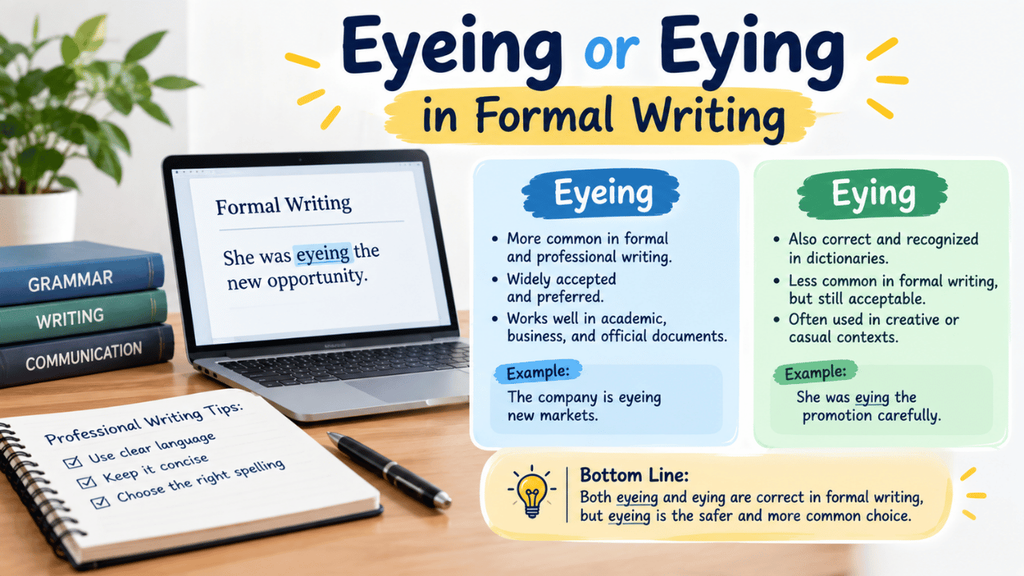
Consistency, when writing an essay, article, report and email or professionals articles is more significant than trying to create a different meaning between the two versions.
If you are going to eyeing, stick to that spelling throughout the document.
For example:
The company is eyeing several new markets.
Later in the same article, avoid switching unnecessarily to:
The company is eying several new markets.
The change is not based on any grammatical or semantic reasoning.
Having a consistent spelling, will make your writing look neater and easier to proofread.
Eyeing In Business and News Writing
You will see “eyeing” used a lot with business, sports and news-style writing.
For example:
The company is eyeing expansion in Asia.
The team is eyeing a place in the final.
Investors are eyeing changes in the market.
In these particular examples, “eyeing” does not imply literally looking at something. Rather, it means to think about, set sights on or have an eye for a potential target.
This metaphorical usage is one of the reasons this word is very versatile.
Eyeing or Eying: Common Errors
The worst mistake is to even think that the two spellings mean different things.
Here are some common problems:
| Mistake | Better approach |
| Assuming eying and eyeing have different meanings | Treat them as spelling variants |
| Assuming eying is always a typo | Check dictionary usage |
| Changing spelling throughout an article | Choose one form and stay consistent |
| Using “looking” when focused interest is intended | Consider “eyeing” |
| Forgetting the context | Check what the sentence is trying to express |
Usage of Eyeing Example in Different Contexts
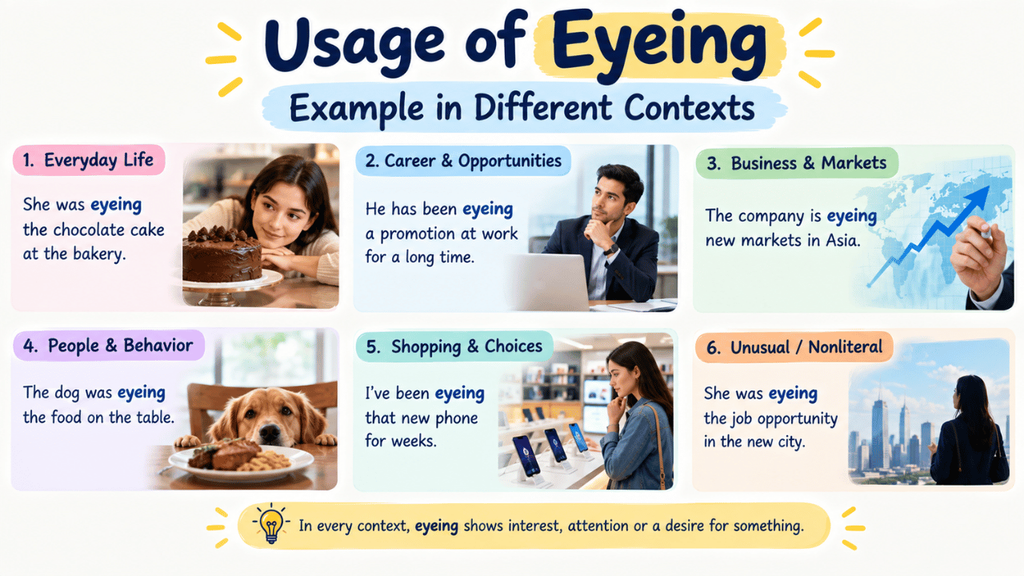
It can fit in a whole host of places.
Shopping
I have been eyeing those shoes since last week.
In this context, “eyeing” means if someone wants to buy (the shoes).
Food
The children were eyeing the freshly baked cookies.
The kids gazed at the cookies.
Career
She is eyeing a management position.
Eyeing here means eyeing for something or as per the context aim.
Business
The company is eyeing expansion into new markets.
In this context, it means an opportunity that the business is considering.
Sports
The athlete is eyeing another championship.
This indicates the athlete’s goal or dream of winning another title.
Relationships
He noticed that someone was eyeing him across the room.
Here, eyeing means looking intensely at an individual.
For this reason, eyeing is sometimes more expressive than simply looking.
Eyeing Can Suggest More Than Looking
The word “look” is broad. You can gaze at the clock, gaze at a wall, or gaze at a photo without any real interest.
In contrast, the word “Eyeing” is often purposeful in ones context.
Compare:
She looked at the dress.
This simply tells us that she directed her eyes toward the dress.
She was eyeing the dress.
Which could indicate that she was interested in the dress, on the verge of purchasing it or taking a closer look at it.
The precise meaning differs based on the context.
That is why eyeing or eying can comes in handy while writing descriptive. It allows writers to express attention and interest without explicitly stating everything.
A Simple Trick To Remember Eyeing or Eying
So remember the base word first, and if you are getting confused in spelling it often.
The base verb is:
eye
To regard with attention or interest.
This can be expressed in present participle format as:
eyeing
or
eying
If you like the spelling that keeps it visually close to the original word, eyeing is straightforward.
Another way to remember it is a simple sentence:
“I am eyeing the thing I want.”
Seeing “eye” clearly inside “eyeing” can make the spelling easier to remember.
Also Read: Pacient or Patient | Comming or Coming | Planed or Planned
Conclusion
The chief provocation of eyeing from eying is this: English spelling does not obey a single predictable rule. The two present-participle forms are more problematic, with the verb “eye” creating a particularly unique case as both eyeing (no e) and eying (e only in -ing form) are recognized.
Eyeing is a common and instantly recognizable spelling in regular writing. That it deliberately maintains the link with“eye.” And eying also is a known variant hence should not just be disqualified as incorrect spellings.
The point is essentially the same: a gaze while regarding someone or something with interest, attention or contemplation.
Choose the spelling that suits your nomenclature in an article, e-mail, school assignment or professional piece and stay consistent. As with many raw platforms, eyeing can be a pretty simple choice when clarity is your main concern – one that most readers will immediately associate in their heads.
The eyeing or eying question is much more manageable once you know the meaning and relationship between the two forms.
FAQs About Eyeing or Eying
1. Is “eyeing” a correct word?
Yes. Eyeing is a form of the verb eye, to look at with interest or attention.
2. Is “eying” also correct?
Yes. Another variant is “eying” – the one you use to write that word in 30-year-old computer programs.
3. Can eyeing be used figuratively?
Yes. As in, “The firm is targeting new markets.” It means it is pursuing or trying to find them.
4. Why does eying look unusual?
This looks strange because in English, the final “e” is usually dropped with the addition of “-ing.” However, both forms are recognized.
5. How do I remember the spelling?
Remember the base word “eye.” If you want the more recognizable word, use “eyeing.”