
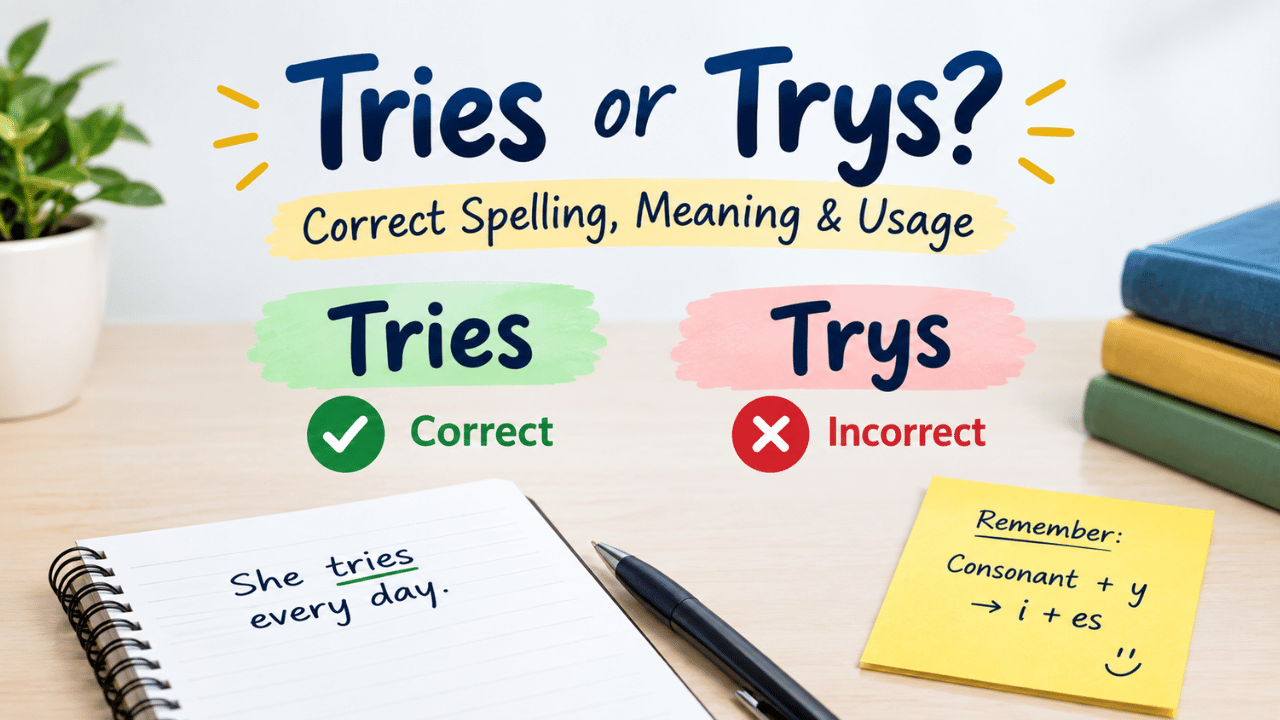
If you’ve ever typed out a sentence, paused, and wondered whether it’s “tries” or “trys,” you’re up against one of English’s more elusive little spelling rules. This is the kind of mistake that you would make sometimes if you are a confident writer, especially when you type so fast, or the word does not seem right whichever way you spell it. The good news is, this question has a very clear and consistent answer once you have the recurring rule in mind.
We’re going to put the tries or trys debate to rest once and for all in this article, explain why one is correct and one is incorrect (and don’t fall into the spelling trap ever again), and also offer you a simple trick to remember it forever.
The Quick Answer
“Tries” is the correct spelling. This is the default for when you need the singular present tense third-person of the verb try, or sometimes as a noun (similar to tries in plural). At least in standard English, “trys” is not a word; it’s simply one person’s name for what most major dictionaries will designate as a spelling error, no matter where you are using it (text message, essay, business email).
This way, every time the tries or trys question comes up, there will be no doubt and no regional standards concerns. “Tries” wins every time. If you searched for “tries or trys” because both versions look familiar, remember that “tries” is the only correct spelling in standard English.
Why Does This Confusion Happen?
The reason “trys” seems correct is because this is how English normally makes plurals and verb matches. The majority of nouns and verbs can just add an s at the end. “Cat” becomes “cats.” “Walk” becomes “walks.” “Jump” becomes “jumps.” By the same token, “try” should now become “trys.”
However, in English there is a tried-and-true spelling rule that applies every time a word ends in a consonant plus the letter “y,” in which an “i” takes the place of the trailing letter when adding “es,” instead of simply slapping on an “s.” This means that, following exactly the same pattern you’ll see with other words like fly or flies or cry or cries, carry or carries, and study or studies, try will yield tries, not trys.
This rule applies if a consonant is before the “y”. But if the letter before the “y” is a vowel, the spelling works differently, and you just add an “s”; your heart doesn’t miss a beat. So words such as “day” become “days,” “boy” becomes “boys,” and “play” to a regular word like, play to plays, but no change in the spelling. The clash between these two frameworks, consonant-y words vs. vowel-y words, is precisely why so many people stop and think twice when writing “tries.” Understanding this simple pattern makes the “tries or trys” question much easier to answer whenever you encounter it.
Where Does “Try” Come From?
“To try”, as a verb, dates back to Old French (and beyond) and has evolved into the streamlined workhorse word we use all the time today and means “to attempt to do or effect something”, when you sample (test) something out or make an effort towards a goal. When English took this word, it took with it the general spelling patterns for words ending in consonants + “y”, and that’s how we have tries as the standard form of its 3rd person singular present tense.
The same kind of “y to i” with an e afterwards is not special to “try.” This occurs in about a third of the entire English vocabulary, which is part of why linguists regard it as one of the more predictable, rules-based elements in a notoriously irregular language.
How “Tries” Is Actually Used
Now that we have settled the “tries or trys” question, let’s look at how “tries” works in everyday sentences. “Tries” is only second- or third-person singular in use, but understanding when to use it can clear things up a lot.
As a third-person singular simple present form of the verb try:
- She tries her best every single day.
- He always tries to arrive early for meetings.
- The dog tries to catch its tail every time it sees it spin.
In all of these examples, “tries” is present simple referring to the habitual (or current) action of one person/animal/entity. This is different from saying, “I try” or “they try,” which are in the base form of the verb and do not include the -s or spelling change that a pronoun in third person singular requires.
As the plural of the noun “try”:
Though rare in conversation, “try” functions as a noun too; that use is more common in context-appropriate sports contexts – for instance, in rugby, a try is an event during play when the ball is grounded by the attacking team.
- The team scored three tries in the first half.
- His two tries in the championship game made headlines.
The third-person singular present tense form “tries” (in both verb and noun forms) adheres to the same spelling rule, showing how consistent this word really is across uses.
Also Read: Pacient or Patient | Seal vs Seel | Girlie or Girly | Hussle vs Hustle
Is “Trys” Ever Correct?
Certainly not, not in any context known to me in standard modern English. Either way, “trys” is not an accepted variation in any major dictionary – such as Merriam-Webster, Oxford, or Cambridge – nor is it a recognized regional variation the same way that some British versus American spelling differences are, like “colour” and “color.” This is not one of those situations. Trys is just a spelling mistake.
It sometimes appears as an unusual surname or brand name in limited, isolated contexts, but that is a proper noun instance and not a legitimate variant spelling of the common verb (or noun) form. “Tries,” as in the verb form to try, is the spelling you need every single time you’re writing about a person trying something, or putting an idea to the test (pass or fail) – although it can also be a rugby score.
Common Mistakes People Make
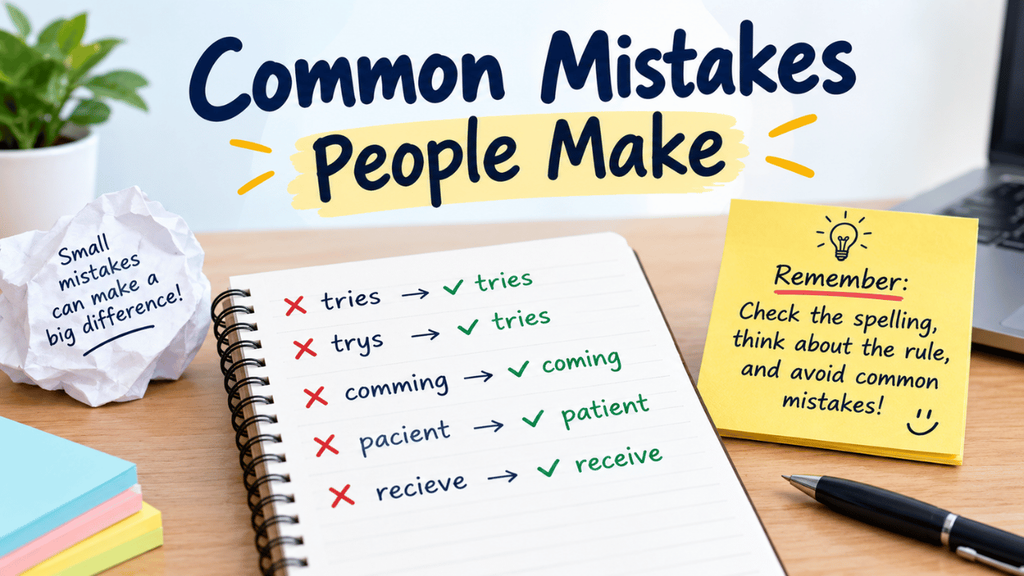
But “tries” represents a spelling change, not a straightforward “add an s” pattern, so it can be easy to mess up when typing fast or when your brain is focused on the meaning of the sentence over its mechanics. Here are a few situations in which this error tends to occur:
Fast typing or texting. When you’re in a rush, it’s so easy to want to revert back to the “obvious” spelling of just adding an s without stopping and thinking about the y-to-i rule.
Confusing it with vowel-y words. Other words, like the simple present tense of “play” (plays) and “stay” (stays), have no spelling changes either, so it’s tempting to incorrectly assume that other word forms work similarly.
Autocorrect gaps. Basic Spell-checkers can catch this error quite reliably, yet others, especially those on some messaging apps, do not always register it and leave the door open for a slip-up.
Using the wrong rule on words that look similar. Because sometimes, after learning this rule, people then incorrectly overcorrect other words (e.g. people who might want to then say the word “key” as “kyes”), it is helpful to understand that the y-to-i shift applies only to consonant-plus-y endings – not every final letter in a word ending in “y.”
We typically catch this kind of error during a final proofreading pass and spell check run, especially on verbs ending in y.
A Way To Easily Remember This Rule
And now an easy tip which will help forever with the right spelling: imagine a complete family of similar (following the same pattern) words: cries, flies, studies, carries and tries. The students who spelled these words correctly knew the generalisation rules that apply to all of them. Whenever you’re confused with try, replace in your mind “try” with “cry,” because everyone knows that cry is not cries but cryed. And that same reasoning directly transmits to “try” becoming tries.
A worthwhile alternative to memorize it is to recount the rule in a simple phrase: consonant + y makes “y” become “i” before you add es. State that same brief rule a few times, and it will stick in your mind many times better than memorizing one single pair of words at a time. The next time you face the “tries or trys” dilemma, think of related words such as “cries,” “flies,” and “studies.”
Why Getting This Right Matters
While it sounds like nitpicking, spelling really does affect the perception of your writing and how professional and trustworthy it appears to readers. Tries is so common that it appears in everyday conversation, storytelling, sports writing, academic essays, and business communication. Even if most of the writing is brilliant and full of great ideas, spelling “trys” can make otherwise strong examples look sloppy.
This is particularly important for students, professionals, and content creators, where regular spellings instill a sense of trust in the readers. One little spelling mistake may not be alone – but if it’s repeated, these spelling slips can slowly erode an audience’s perception of how seriously they should take your writing.
Also Read: Comming or Coming | Planed or Planned | Bearly or Barely
Conclusion
If you still find yourself searching “tries or trys,” use the consonant + y rule as your quick spelling check. The tries or trys debate has a definitive, confident answer: Tries is correct, and trys is a straw-term not found in any English dictionary you would ever need. That boils down to the fact that words with a consonant and “y” at the end have a reliable rule in English: you turn the “y” into an “i,” then tack on “-es.” You can find this repeated dozens of times, across dozens of other everyday words (cries, flies, studies).
As soon as you get this rule down, you’ll never have to hesitate and doubt again. So, if we’re writing about someone’s attempt to succeed or the score of an international rugby team, “tries” is always going to be your spelling.
FAQs About Tries or Trys
1. Is “trys” ever correct?
No. It should be spelled Tries respectively.
2. Can “tries” be a noun?
Yes. In rugby, tries is the plural of try.
3. Is “trys” an informal spelling?
No. “Trys” does not exist in English international language.
4. How do I recall the spelling?
True; also consider similar words such as cries and flies.
5. Will autocorrect catch “trys”?
Not always, so it is better to check yourself for spelling.