
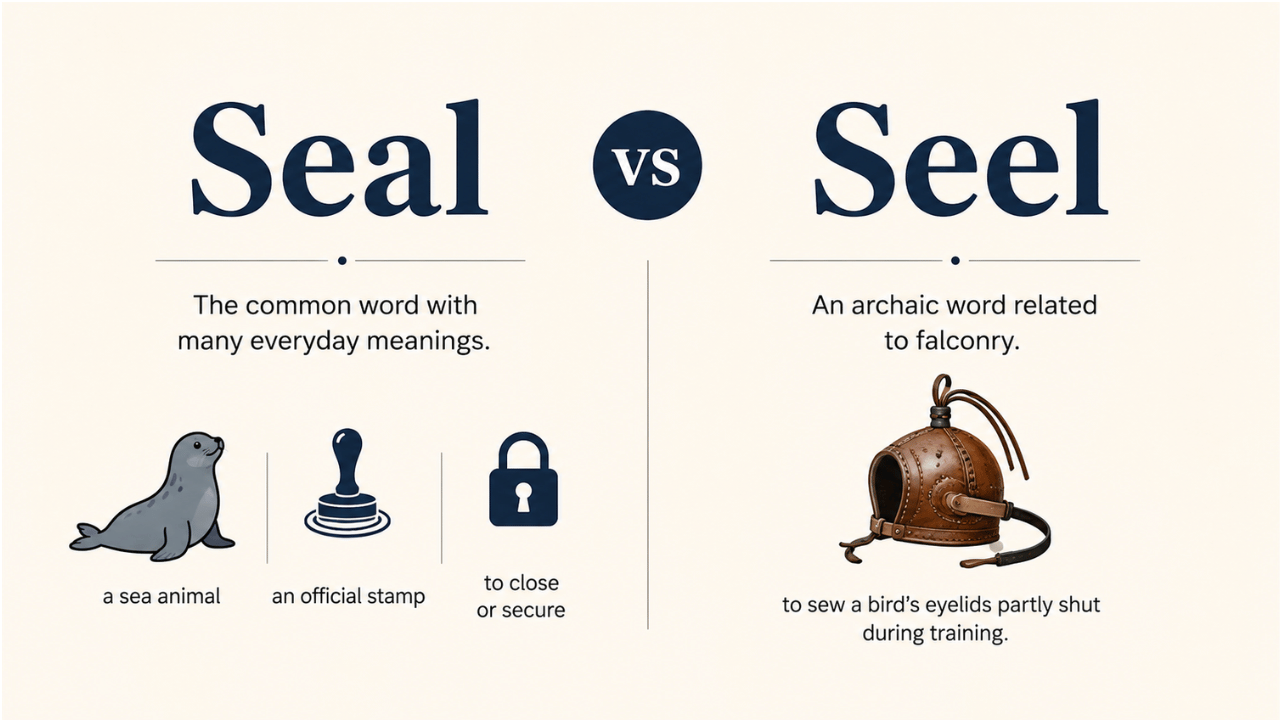
There are plenty of entirely different meanings packed into pairs of homophones in English, but the difference between seal vs seel illustrates just how subtle this can be. If you typed one of these words and find yourself hesitating, wondering whether you’d misspelled it, you’re not imagining it. These two words literally sound like the same word when spoken, yet only one of them has a place in modern-day nonliterary writing.
This article will take you through what each word means, their origins, and grapple with why there is confusion between seal vs seel in the first place. You will never, ever have to wonder about which spelling to reach for again.
The Short Answer
If you’re short on time, the takeaway is this: “seal” is the word you want in nearly every modern circumstance. It is ubiquitous, adaptable, and familiar – whether it’s referring to a water-dwelling creature or an official seal, or for closing something firmly. In contrast with this, the word “seel” is largely archaic and has basically disappeared from ordinary English except in historical texts, specialized falconry writing, and sporadic references in literature.
So, even though technically both words exist, the seal vs seel thing is not really a flip of the coin. Unless, of course, you are writing about medieval falconry methods, “seal” is pretty much guaranteed to be the correct word.
What Does “Seal” Mean?
“Seal” is one of those really annoying words in English that can serve both as a noun and a verb, and it contains multiple definitions across its various meanings.
The term seal serves as a noun meaning:
A marine mammal. Seals are sleek, flippered animals found in oceans and coastal waters around the world, known for their playful behavior and ability to glide gracefully through the water, despite being ungainly on land.
An official stamp or emblem. Consider a basic wax seal on an envelope, or the seal of a notary stamped on some legal documents, or the government seal printed in an official certification. Its use goes back centuries, when physical seals were employed to validate documents and reinforce their unaltered nature.
A mechanism that prevents leakage. In engineering and manufacturing, a seal is defined as a component that prevents the passage of liquids or gases through the gap between two surfaces; For example, this includes a rubber seal on a car door or a gasket seal in a water pipe.
Sealing is the act of closing securely, finalizing an agreement or something else into a route that gets airtight, so to seal. For example, you seal an envelope before sending it in the post, seal a business deal after lots of discussion or seal a container to preserve its contents.
Some natural examples:
- The kids spotted a seal sunbathing on the rocks near the harbor.
- She sealed the letter with an old-fashioned wax stamp.
- Make sure to seal the jar tightly so the jam doesn’t spoil.
- After months of negotiation, both companies finally sealed the deal.
With its wide definition (wildlife, legal documents, and mundane household items), “seal” is one of the most commonly sounding out words in English, but once you read it in context there will almost never any ambiguity as to which meaning you’re looking at.
What Does “Seel” Mean?
That’s where things really start to get cool. Seel is a valid word; it simply exists within a very niche historical branch of English: falconry.
The word “seel” historically referred to the practice of using a fine thread to temporarily partially sew shut the eyelids of a raptor. It was something you did at the beginning of training a hawk or falcon, in order to keep the bird eased and so it would be less stressed out as it learned to be handled by humans. Usually leaving a small gap cause the bird to still see a little light, but its vision was otherwise completely blocked until the thread was later cut off.
Now, this may seem like an odd and slightly disturbing practice by modern standards, but it was a previously recorded part of traditional falconry for centuries in the medieval European Narrative. Some older literary works and history books, in some cases more loosely reiterated the idea of “seeling” the eyes as actually, anything that blinds or obscures one’s vision or judgment.
Seeling the eyes of a bird is no longer standard practice in falconry, and the word itself has fallen almost entirely out of active use as of today. Because you’ll mostly see “seel” as historical interrogation on falconry, old texts, or etymology rabbit holes, such an entry is headed into.
Also Read: Girlie or Girly | Hussle vs Hustle | Roster or Roaster
The Dangers of Confusing the Words Seal vs Seel
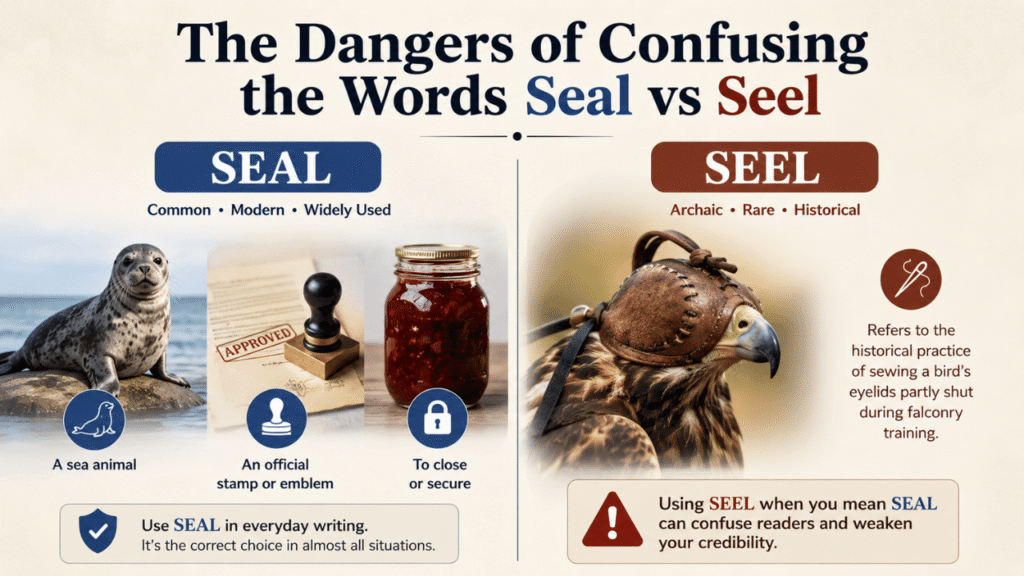
With seal vs seel, the confusion is, in fact, a rather straightforward one: these two words are homophones; they’re pronounced in precisely the same manner and their spellings and completely different meanings are also taken into consideration. As you may know, English is full of these tricky pairs – with words that sound alike but have different meanings and spellings, and when it comes to something we hear rather than read, our brains tend to fall back on whichever spelling feels most familiar.
It spell correctly because “seal” is an everyday word from nature documentary shows to office paperwork, thus its the spelling that most people will naturally go for. “Seel”, by contrast, is barely ever seen such that most people don’t even consider it a word until they find it in some dusty old tome or a conversation just like this one. The difference between those largely becomes easy to remember once you know the story of “seel,” and where it fits in its relationship to falconry; however, that wildly important detail did not present itself when I touched upon this word.
Autocorrect and spell-checkers sometimes make it more confusing. Some spell-checkers won’t flag it as a mistake – “seel” is a proper dictionary word and should be prohibited only were “seal” was clearly the intended term, for example. In other words, unless you are specifically looking, not even a small typo can escape your notice.
Overview of: Seal vs Seel
Let me clarify the distinction with a simple explanation.
Carnality: “Seal” is now used in English words extremely commonly. Rare, archaic, and largely obsolete is the term seel.
Meaning: Seel, which describes the actual falconry practice of partially closing bird eyelids.
Context: “Seal” is common in casual conversation, business articles, science writing, and nature writing. “Seel” is a term that almost only appears in historical, literary or specialty falconry texts.
Part of speech: “Seal” can be both a noun and a verb in different senses. The term “seel” works primarily as a verb, with one narrow type of meaning.
When You Should Be Using “Seel”
The simple answer for almost every writer you speak to is: Very rarely if at all. The second example may be more contentious, but unless you’re writing a historical novel that includes a falconer, researching medieval hunting practices or discussing the etymology of various English words for birds of prey in an online article (as I am), chances are you won’t have any very good reason to include “seel” in modern writing.
If you do see “seel” during older literature read, do not presume it is a mistake. Instead, understand it as a deliberate allusion to this ancient practice of falconry and allow the context to assist you with interpreting the passage.
Simple Trick To Keep Them Straight
As a mnemonic device to help you remember for good which is seal and which is seel, imagine the head of a seal balancing an orange ball on its nose in an aquarium somewhere. That playful, familiar image is perhaps the best anchoring for a correct spelling of the word you’ll be using in your everyday life. Here’s what “seel” means: to cover the bird’s eyes, which connects with the word conceal, and in your mind you can link it to it.
When (inevitably) you’re unsure about what to write, you can almost always default to seal; it covers literally every situation you’ll run into.
Also Read: Eventhough or Even Though | Comming or Coming | Planed or Planned
Conclusion
The seal vs seel comparison serves as a timely reminder of the wealth of history that can be concealed in a single word. “Seal” is the obvious pragmatic choice for most day-to-day writing, from animal taxonomy to legal agreements to basic household chores. “Seel,” for its part, is an intriguing remnant of a medieval method of falconry that factored into hundreds of years ago but mostly died off long ago, as the trait remains present primarily in historical literature – and paltry etymological oddities such as this.
Now, whenever you’re typing and this word comes to mind, you’ll know which spelling you want on the page, and maybe have a fun fact about where the other one originated.
FAQs About Seal vs Seel
Is “seel” a real word?
Yes. It’s an old word related to the sport of falconry and is not just a misspelled seal.
What does “seel” mean?
It derives from a traditional technique used in falconry to keep a bird peaceful by sewing their eyelids partly shut while being trained.
Is seeling still practiced?
No, Seeling is not practiced in contemporary falconry and has primarily historical interest.
How are seal and seel pronounced the same?
They are known as homophones, meaning the words sound the same but have different spellings and meanings.
Does spell-check catch “seel”?
Not always, because the word “seel” is real.