
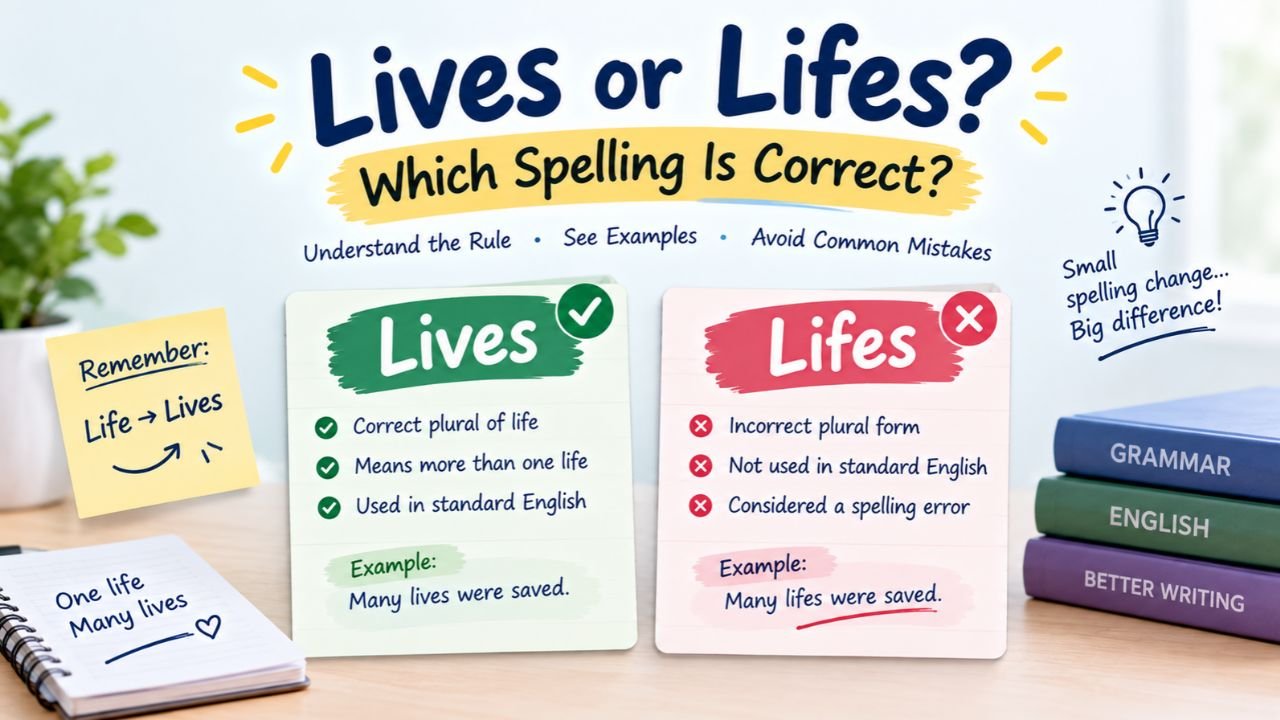
There is a perplexity in English grammar when an easily understood word alters its spelling when they change to the plural form. For example, lives and lifes are often mixed up. They all look good on the surface, but only one is correct in Standard English when talking about more than one life.
If you ever asked yourself whether to write lives or lifes, the answer is not complicated: lives is the correct plural of life. The indefinite uses of the word lifes are stretching into spelling errors.
So, in this article you will see the differences between lives or lifes, grammatical rules related to that spelling (and why), practical examples so you can apply it yourself, and answers to frequently asked questions so the correct one is no longer a mystery for you.
Quick Answer: Lives or Lifes?
Lives is the correct form when referring to more than one life. Regular nouns form their plurals simply by adding-s to the word, but life is an irregular plural noun.
For example:
- Singular: She has an interesting life.
- Plural: They have interesting lives.
- Incorrect: They have interesting lifes.
The word lives is as a verb, like she lives in Delhi. However, its meaning varies depending on context.
What Is The Difference Between Lives or Lifes
The only major difference between lives or lifes is grammatical correctness. Lives is the correct plural of life, whereas lifes is an incorrect spelling of that same plural.
| Feature | Lives | Lifes |
| Correct plural of life | Yes | No |
| Meaning | More than one life | Incorrect spelling in this context |
| Used in standard English | Yes | No |
| Example | Many lives were saved. | Many lifes were saved. |
An easy way of remembering this is to note that spelling changes from f to v before the plural ending for when you compare lives or lifes.
This is the reason why we say several life were impacted instead of several lifes were affected.
What Does the Word Life Mean?
First, it is useful to grasp what the singular noun life means before figuring out its plural form.
Life may pertain to the condition of having living organisms; biological processes – namely birth, reproduction and death – or experiences and events that constitute an individual human’s life. It can sometimes allude to a moral point in someone’s way of living, to a person’s journey as a human.
For example:
- She enjoys a peaceful life in the countryside.
- His life changed after he started a new job.
- Everyone deserves a happy life.
- Exercise can improve your quality of life.
Here, life is one existence, experience, or way of living per sentence.
And when you are talking about what a few people have done, or more often the lives of several individual human beings (as used in more than the words that give expression to their being), you use the plural form: lives.
Also Read: Manual vs Manuel | Comming or Coming | Planed or Planned
Why Life Becomes Lives, Not Lifes
There are two kinds of plural Word Formation concepts: Many English nouns form their plurals by adding -s or -es. Like we take book to books, chair to chairs, and box to boxes.
Yet English has many irregular plurals which do not follow this easy structure.
In English, some nouns that end in -f or -fe change the endings to –ves when they are made plural. The same goes for the noun life.
Here are some common examples:
| Singular | Plural |
| Life | Lives |
| Wife | Wives |
| Knife | Knives |
| Wolf | Wolves |
| Leaf | Leaves |
| Shelf | Shelves |
While this is the rule many people are used to, not all words ending in -f or -fe fall under this spelling pattern. Like, roof typically becomes roofs.
So, it is helpful to know the plural of every word rather than relying on rule-based noun plurals for all nouns.
Proper Usage of Lives in Sentences
Using Lives in a sentence, you also need to know the meaning of each word and use them correctly from site.
Seeing this grammar presentation in real life situations is the best way to understand a rule. Lives is typically used either when talking about people, animals, experiences and results of certain events.
Here are some examples:
Talking about people:
- Our lives have changed significantly over the years.
- Different people lead different lives.
- Their lives became easier after moving to a new city.
Talking about safety:
- The firefighters saved several lives.
- Doctors work hard to protect lives.
- The accident put many lives at risk.
Talking about experiences:
- Travel has changed our lives.
- Education can transform lives.
- Friendship brings happiness into our lives.
These examples demonstrate that lives is appropriate whenever the sentence refers to multiple lives or the experiences of multiple people.
Can Lives Also Be a Verb?
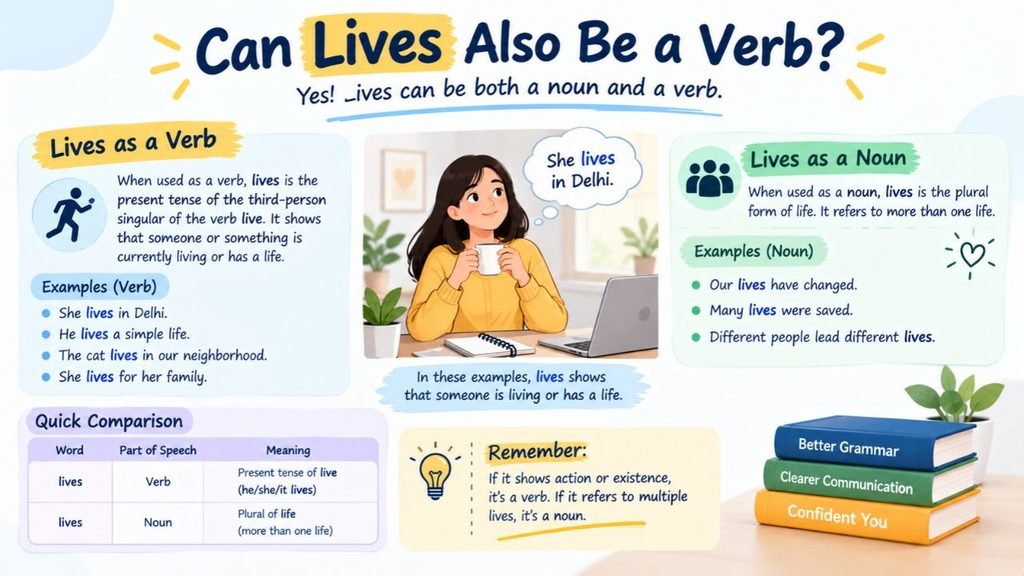
Yes. Another cause for the troubled mindset regarding lives or lifes, is that the word lives carries more than one grammatical function.
The plural noun form of life is lives. Second, it is the present tense of the third-person singular of the verb live.
Lives as a noun
When used as a noun, lives refers to more than one life.
Examples:
- The rescue team saved many lives.
- Their lives changed after graduation.
- The documentary explores the lives of endangered animals.
In these statements, lives are human existences or the humanity.
Lives as a verb
The verb to live means a place of residence; the manner in which one is.
Examples:
- She lives in Mumbai.
- My brother lives near his workplace.
- He lives a healthy lifestyle.
- Their grandmother lives with them.
In these examples, lives does not represent several lives. This describes the act or state of being alive.
It is the structure of these sentences that provides meaning.
Common Errors In Choosing Between Lives or Lifes
Spelling mistakes were made even by those who spoke English perfectly. Knowing why these errors happen can help you avoid them.
1. Adding only -s to life
This is another case of people confusing life with lifes, a mistake frequently made due to the fact that most regular nouns form their plurals by adding -s.
Incorrect: We should appreciate our lifes.
Correct: We should appreciate our lives.
The noun life is an irregular plural so that its spelling changes.
2. Confusing singular and plural forms
Use life when it comes to one person and lives when there are two or more.
Examples:
- Singular: She has a busy life.
- Plural: They have busy lives.
Using the right Urdu form makes your sentence clearer and grammatical.
3. Using the wrong spelling in formal writing
Its written lifes in a school assignment, college essay, professional email or even a blog post may have been flagged as a spelling mistake.
Always check your stuff before submitting it or publishing it. A quick check is one of the best and easiest ways to catch mistakes that you might miss while actually typing.
Everyday Expressions That Use Lives
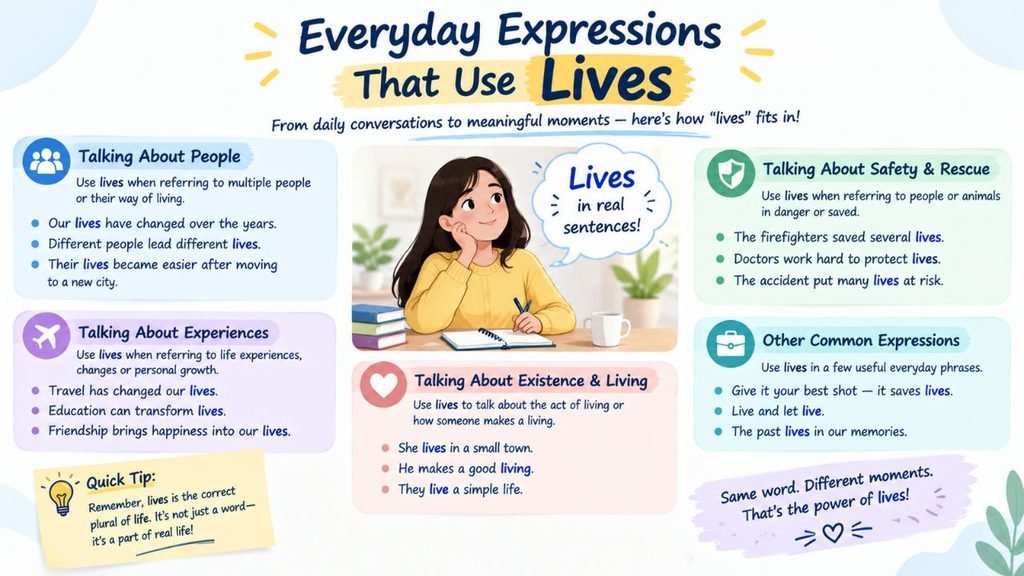
Although they are still use in common English phrases lives and days are the more commonly used forms. If you can learn these phrases, the spelling is much easier to remember.
- Our lives: Refers to the experiences of multiple people.
Example: Technology has changed our lives in many ways.
- People’s lives: Refers to the lives or experiences of different people.
Example: Education can make a positive difference in people’s lives.
- Personal lives: Refers to the private experiences of multiple individuals.
Example: The actors prefer to keep their personal lives private.
- Busy lives: Describes people who have demanding schedules.
Example: Many working professionals lead busy lives.
- Saving lives: Refers to protecting people from death or serious danger.
Example: Emergency workers dedicate themselves to saving lives.
Every expression involves the identical plural form. Had lives been replaced with lifes, these phrases would be incorrect in traditional English.
Handy Tip to Remember the Correct Spelling
If you constantly forget when to write lives and when to write lifes then there is a trick, almost like a mnemonic.
Remember this pair:
Wife → Wives
Life → Lives
The two words share a pattern for plural spellings. Just remember wifewife, it may remind you that life → lives too.
Also, you can keep the core principle in mind.
One life, two lives.
Say the cliche out loud, write it down a few times and put it into more sentences. Constant exposure will make the right spelling instinctual.
Also Read: Eyeing or Eying | Tries or Trys | Seal vs Seel | Girlie or Girly
Conclusion
Once you learn how to make a word plural, it is easy to know that lives or lifes are two totally different words. Many English nouns take on an -s for the plural, and although this seems to be the case with life, it is one of those exceptions that makes us all cringe as we quietly whisper pluralization attempts into our computer screens.
It is lives – whether human beings, livestock, your life story or the phrases saving lives and our busy lives. Lifes, however, are best avoided when intending to mean more than one life.
And remember that lives has both noun and verb forms. The meaning of the sentence depends on its context.
Remember the simple rule: one life, many lives, and you will not have any doubt about using the correct spelling in daily conversations, academic papers, and the workplace.
FAQs About Lives or Lifes
1. Does word lifes is a correct English?
Lifes is not the correct plural of life. The correct spelling is lives.
2. What is the plural of life?
The plural of life is lives. Such as “One Life, Many Lives.”
3. Why is it lives instead of lifes?
Life is modeled on a kind of irregular plural in which the end switches from -fe to -ves.
4. Does lives used as a noun and verb?
Yes. Lives as a Noun: More than one life. You are the third-person singular form of live; to use it as a verb: “She lives in London.”
5. Is it “saving lifes” or “saving lives”?
The term is “saving lives.” When using lifes as the plural of life, it is actually misspelled.