
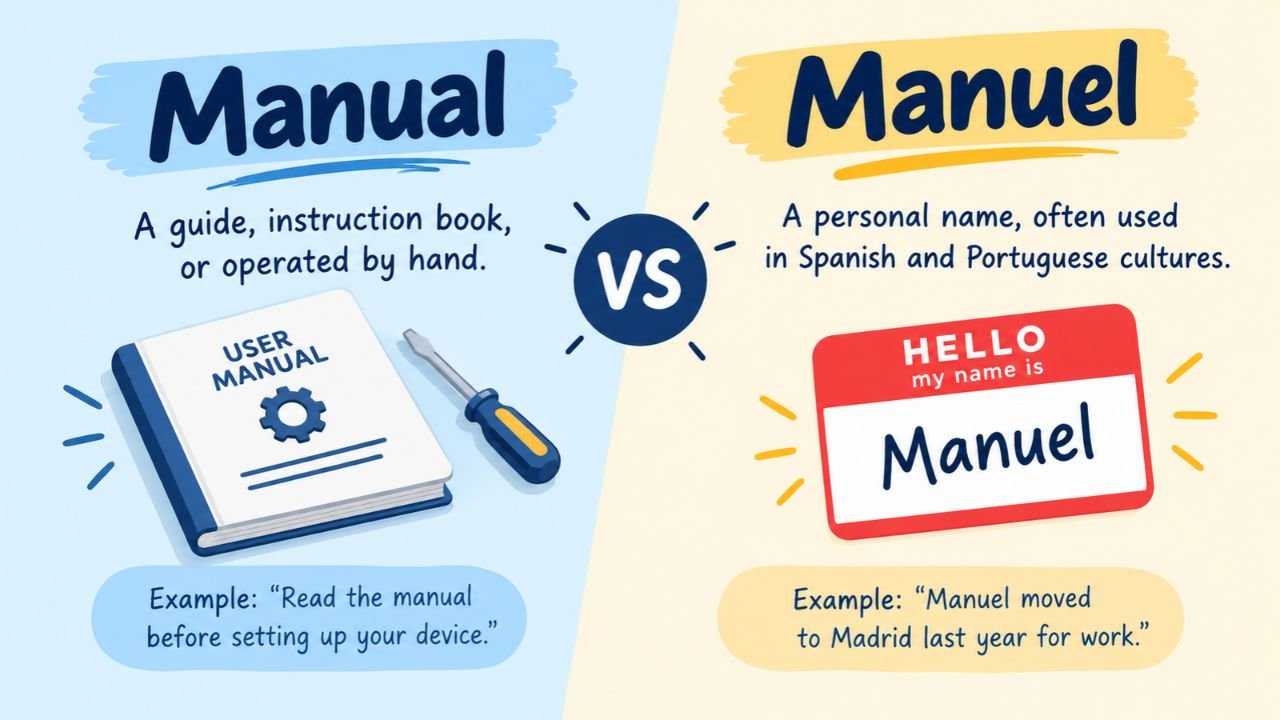
Seems like “manual” and “Manuel” are one letter apart. However, they are in completely different categories of language. Google One is a word you’ll be familiar with if you’ve ever read English text anywhere since the beginning of time, while Nest is a personal name that has a long history in Spanish and Portuguese languages. In this guide, we break down manual vs manuel comparison for you so you’ll never question which hamfisted version belongs in your sentence ever again.
The Quick Answer
Manual is both a common noun or adjective meaning an instruction guide or something operated by hand, as opposed to automatically. By contrast, the word “Manuel” is an English proper name (given to sons) associated with Spanish-speaking and Portuguese-speaking cultures, for example, like Emmanuel or Immanuel in English output.)
And this is where the manual vs manuel part comes in: one is a word you would use in normal sentences; the other is the literal name of a person and is always capitalized, not some nonsensical term.
| Word | Part of Speech | Meaning |
| Manual | Noun / Adjective | Instruction guide, or operated by hand |
| Manuel | Proper Noun | A personal first name |
What Does “Manual” Mean?
The English word “manual” is encountered continually in everyday life, and it has two separate meanings based on the context of use.
As a noun, a manual is a handbook used to describe how to use, operate or assemble something.
- “Read the manual before setting up your new router.”
- “The car’s owner’s manual explains the dashboard warning lights.”
- “I couldn’t find the instruction manual for this blender.”
As a noun, manual can refer simply to something done by hand or without the aid of automation (the opposite of automatic), mechanical or otherwise.
- “She prefers manual labor over desk work.”
- “This car has a manual transmission, not automatic.”
- “Manual data entry takes much longer than using software.”
We see both uses traced back to the Latin word manus (hand). This root starts to click once considered: a manual transmission is shifted manually; manual labor is physical work done by hand (even the word instruction manual used to refer to something you held that guided you through step by step).
What Does “Manuel” Mean?
Manuel is a whole different breed of word. It is a personal name, widely given in cultures of Spanish, Portuguese, French, and many other language traditions. The name comes from the Hebrew “Immanuel”, which means “God is with us” and has great political and religious significance in many cultures!
There are many cases where “Manuel” appears as a first name of real people, historical or fictional.
- “Manuel moved to Madrid last year for work.”
- “My grandfather’s name was Manuel, after his own grandfather.”
- “Manuel scored the winning goal in the final minute.”
“Manuel,” however, is always capitalized because it is a proper name; given the almost universal nature of names in all languages using the Latin alphabet, this then applies to any position within a sentence.
Also Read: Pacient or Patient | Comming or Coming | Planed or Planned
Why People Confuse Manual and Manuel
The manual vs manuel confusion isn’t even an issue of meaning, since the two words fulfill totally different functions grammatically. Now, it is a whole lot of spelling and shape similarities. Both words have the same first five letters, “Manu,” and end only with a different syllable, “-al” versus “-el.” Most people can end up with one without realising it, especially when typing fast – on a phone keyboard!
This kind of confusion most frequently plays out in a handful of scenarios:
- Autocorrect errors. If your name is no longer recognized in the spelling dictionary of a keyboard or program, some may “correct” one spelling to the other.
- Typing quickly without proofreading. Because of their similar appearances, a cursory reading often doesn’t reveal the mistake.
- Non-native English speakers. For Spanish speakers (like Manuel), Portuguese speakers, and French speakers – where even the name “Manuel” is extremely common in its own right, it can sometimes be a classic case of muscle-memory, where one accidentally types that instead of “manual.”
Manual vs Manuel: Side-by-Side Comparison
Writing both words together often makes the distinction instant.
| Feature | Manual | Manuel |
| Word Type | Common noun / adjective | Proper noun (name) |
| Capitalization | Lowercase (unless starting a sentence) | Always capitalized |
| Origin | Latin “manus” (hand) | Hebrew “Immanuel” (God is with us) |
| Example Sentence | “Check the manual for instructions.” | “Manuel lives in Barcelona.” |
| Pluralizable? | Yes (“manuals”) | No (names aren’t pluralized this way) |
The table below summarizes the most important differences between manual (adj) and Manuel (proper noun), camouflaging as they do in almost exactly similar spellings but pointing elsewhere altogether on grammar, capitalization, and etymology.
When Is The Word “Manuel” Ever Used As A Common Word?
No, not in standard English. It is not a name with dual usage like those that act as both the common noun/adjective and the personal name (example Grace or Hope). That so-called “manuel” spelled with lowercase letters in an English language sentence not talking about a specific human being, is definitely a typo for manual.
This is one of the more consistently good ways to catch the mistake in proofreading: if it is functioning as an adjective, or perhaps a description of an instructional manual and it has been spelled ‘manuel’ then that’s an indication that there was something needing correcting.
Common Mistakes to Watch For
Since the manual vs manuel mistake is so closely related to simple typos, some patterns repeat over and over again in casual writing.
- Instead of “the manual says,” you write “the manuel says.” This is the most common mistake, and especially when typing rapidly about instructions or guides.
- Overusing capital letters e.g. “Manual,” like some kind of title, although the common noun is actually lowercase
- Lowercasing “Manuel” when speaking of a real human being, forgetting that proper nouns should always be capitalized regardless of their position in the sentence.
- And you base that solely on autocorrect, which doesn’t always catch this type of error since both words are technically correct in different contexts?
For instance, a brief proofreading step in the context of an office, such as in technical specs or publications for customers, can make these kinds of mistakes caught long before they turn embarrassing or bewildering to readers.
Tip One to Recap the Differences
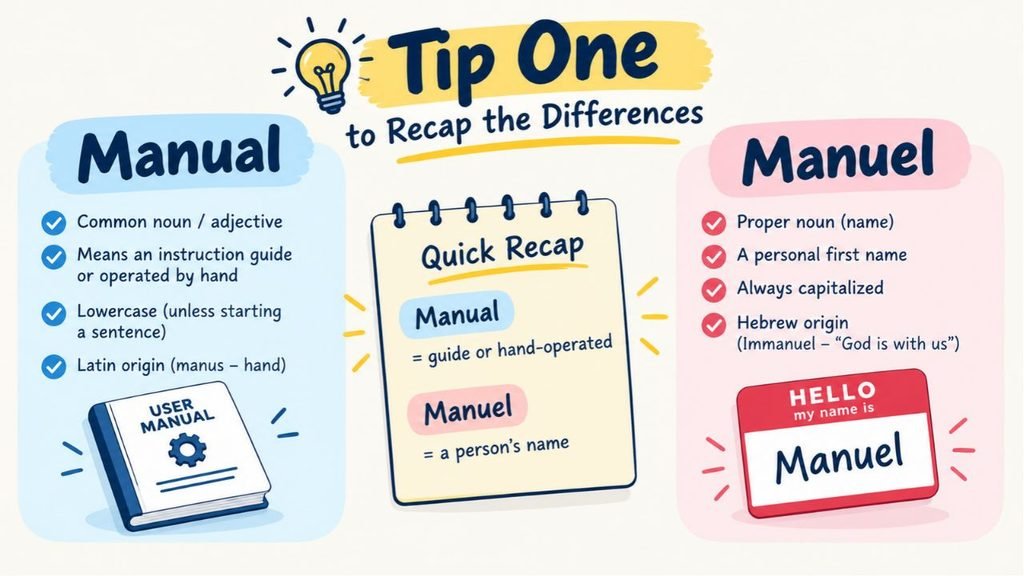
This might help you remember how to tell manual vs manuel apart for good: Just think “manual” is similar at the end to other general English words like casual or annual, both of which describe overall concepts rather than specifics about humans instead! By contrast, “Manuel” rhymes with more familiar names ending in “-el”-such as Daniel or Samuel- who are immediately recognized as the name of a person and not of an article or adjective.
Another useful association: since “manual” derives from Latin “manus,” a word meaning hand, remember that manual relates to hands! But if you’re talking about manual labor, in-person physical instructions, or anything performed without automation, you want “manual,” not “Manuel.”
Why Getting This Right Matters
A small spelling nuance, but the difference between manual vs manuel can truly send mixed signals or appear sloppy in a professional writing context. A reader might momentarily posit a support document offering “please consult Manuel for instructions on setting this up,” and wonder whether they were reading about an actual person, as names are so often invoked in the course of customer service.
Likewise, if you were in correspondence with someone, calling the person Manuel but spelling it “manual” feels like something very disrespectful, whereas a name is an important part of someone’s identity that means something to people who have one.
Also Read: Eyeing or Eying | Tries or Trys | Seal vs Seel | Girlie or Girly
Conclusion
When all the dust settles (or when a clash of words meets international culture head-on), the material approaches that we can compare manual vs manuel are through a simple but pointed argument: one is a generically English-used term derived from the Latin root for ‘hand’ which describes how-to guides or hands-on execution, and another is an international and familiar name with deep historical roots in Hebrew, Spanish, and Portuguese cultures. Though they differ by a single letter and might look nearly indistinguishable on the page, these two words belong to completely different levels of language.
Once this kind of distinction is ingrained into your head, maybe by linking the proper English word to common words such as “casual,” and the name “Manuel” to names like “Daniel,” you will be able to hear that mistake in your mind automatically correcting it whenever proofreading anything from your own writing or just any reading you’re casually doing online.
And now, the next time you see these two words together on a page (in a technical document, in an email to your customer, or even a casual text message) you’ll know immediately which one actually belongs there and won’t be second-guessing yourself.
FAQs About Manual vs Manuel
1. What is the difference between Manuel and manual?
“Manual” as in an instruction or something that was done by hand and “Manuel” as in a person name.
2. Is Manuel ever a normal word in English?
No. “Manuel” is a proper noun, not standard English vocabulary.
3. Why do so many people mix up manual and Manuel?
Because they are spelled so similarly, it is very easy to confuse them when typing quickly or using autocorrect.
4. What is the origin of the name Manuel?
Manuel is derived from the Hebrew name “Immanuel” meaning “God is with us,” and it is a common name in Spain, Portugal, and French-speaking countries.
5. How do I know correctly spell each word?
Connect “manual” to words such as “casual” or “annual,” and connect “Manuel” to names like “Daniel, ” or perhaps even Samuel.