
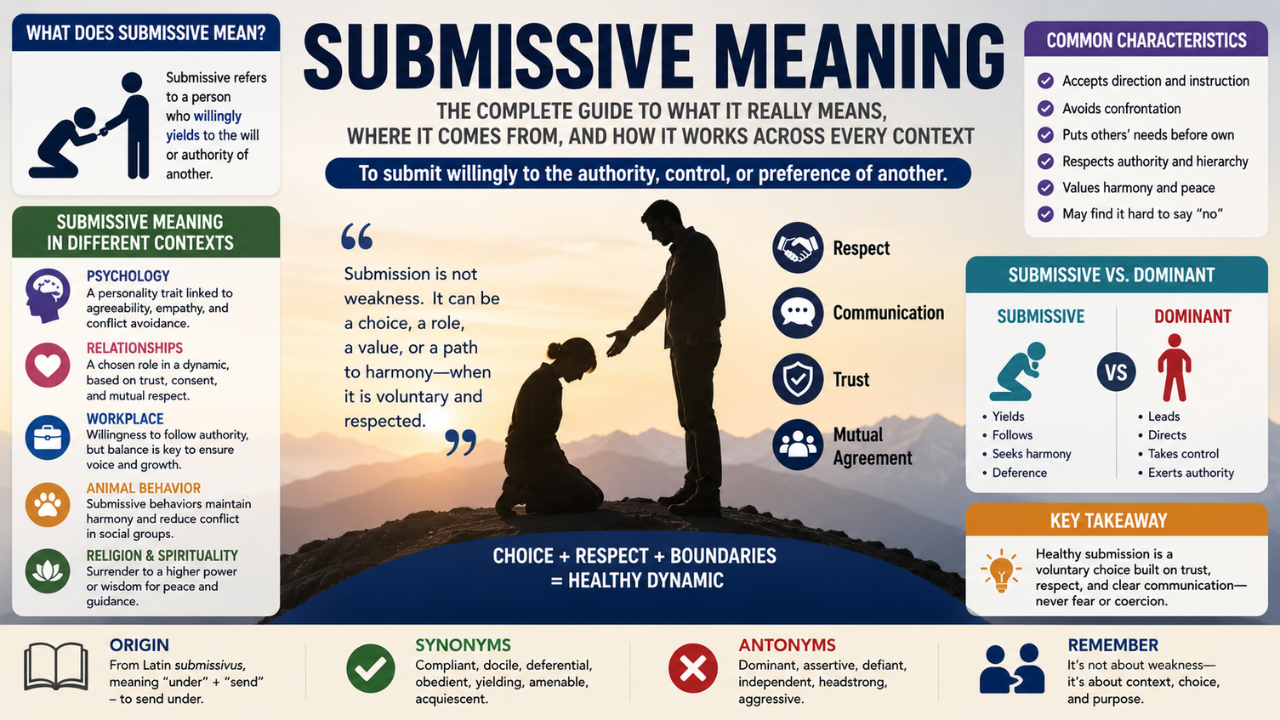
Words have weight far beyond dictionary definitions. Some words come to you without their full nuance and become caught up in cultural assumptions; their meaning is burdened by who says them, in what context, and with which intent. The submissive definition is one of the most clear instances of this. Open a psychology textbook, an advice column about relationships, a philosophy paper, or a social media argument; in every case, “submissive” comes up to do some work differently in each context (sometimes neutral/benign work; sometimes charged; sometimes the topic of fundamental disagreement).
This super simple guide is designed to clear all of that confusion. When you are done reading, you will have a deep, true, and truly actionable understanding of submissive meaning: its etymology, its definition in one sentence, how it is used in psychology, relationships (dating & marriage), professional life (workplace), animal behaviour [and] culture; including common misconceptions/mistakes with submissive meanings and its synonyms/ antonyms. No oversimplification. No moralising. Just clarity.
Origin Of The Term Submissive
Even knowing the meaning of a word is always enhanced by knowing its etymology. The term “submissive” originates from the Medieval Latin word “submissivus,” which means “humble” or “submissive.” The root is “submittere,” consisting of “sub-“, meaning “under,” and “mittere,” meaning “send.” Therefore, it essentially means “to send under” or “to lower oneself.”
The word “submissive,” for example, was borrowed into English in the late 16th century in reference to one who yields to the will or authority of another, someone eager to comply and obey.
The architecture of this meaning is clear in the Latin: sub (under) + mittere (to send or put). When you are “submissive,” you submit to someone else – which literally means that your will takes a backseat to his. That original notion of putting yourself under someone, not in a flow but in a structural, positional sense, has been preserved in English since its earliest use over four centuries ago.
The Core Definition of Submissive
Submissive is an adjective; it refers to a person or animal inclined to submit, surrender, or yield to the will of someone else. Depending on the context, it can be neutral, specific, or sensitive.
Of course, a 2025 analysis offers a simpler working definition for everyday purposes: “submissive is someone who gets on comfortably and willingly with the direction, control, or preference of other individuals (as part of achieving any partnership in the personal, professional, or social domain)”.
There are a few components of that definition worth breaking out:
“Things are readily available for you to take” – This phrase has a lot of grunt work. The meaningfully deliberate use of the word submissive suggests a measure of volition. He who is forced to submit under an evaluation of coercion, fear, or threat does not submit in the rich psychological sense of submission – he submits in a control. The kind of submissive most appropriate to the modern ear is consensual, voluntary deference, not involuntary submission.
“Leadership, control or preference” – What you’re deferring to is not simply raw power. It is sometimes expertise, or experience, or a role agreed upon by others. In a classroom, a student is submissive to teachers in a functional way (the nature of the social situation makes it appropriate).
“Seek harmony, avoid dispute or work within a hierarchy” – This captures the motivators to behave submissively; they are more benign than pathological. For many human social systems, some members need to defer to others some of the time.
Also Read: FT Means What? A Complete Guide to This Common Abbreviation
Submissive Meaning Across Different Contexts
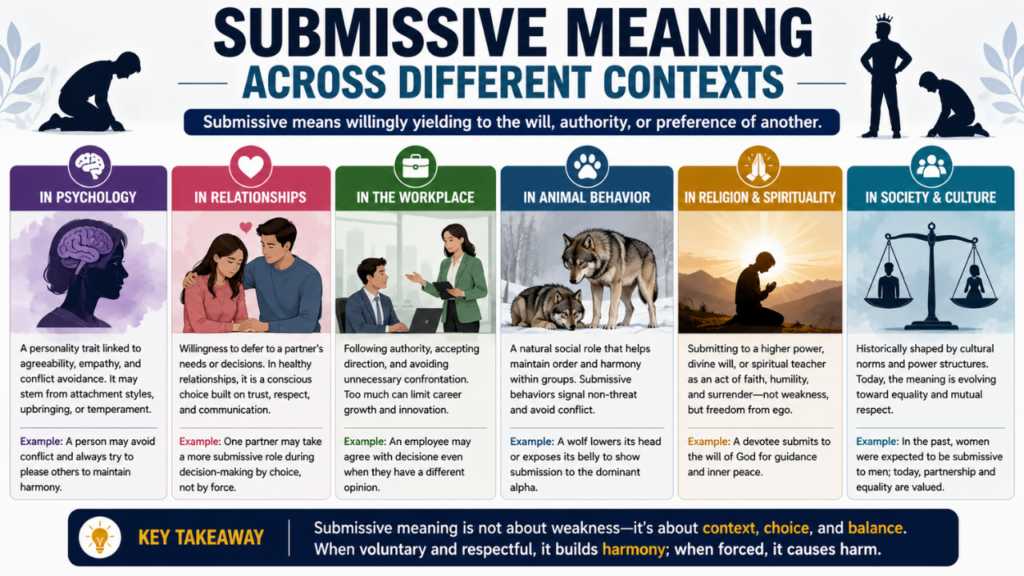
What the adjective means as it becomes a noun minutiae of submissive can waver and vary depending on what field you are using it in. Here is a complete breakdown.
In Psychology
By the way, a submissive personality type in psychology is often considered opposite to more dominant or aggressive personality traits. Personality characteristics like agreeability, empathy, and impulse control might determine submissiveness, according to a new study.
Submissiveness as a trait on a spectrum is an idea studied in clinical psychology, yet it has no fixed category. This can be seen in personality assessments, in research relating to attachment theory, and particularly therapeutic work around training assertiveness. Some of these behaviours could be associated with the presence of particular personality types (should binding style = submissive), or behaviour restrictions which may fluctuate in tandem with an individual’s attachment styles.
Crucially, a submissive nature does not have to mean one is unhealthy or disordered. They are not clinically significant until they consistently stop a person from either expressing true needs, maintaining boundaries, or getting support for the safety of their well-being. Someone who is naturally agreeable and conflict-averse, and comfortable with that, is not the problem. Someone having the pressing need to say no but feeling they cannot, and that is a very different scenario requiring different support.
In Relationships
When we talk about submissive meaning in our relationship in English, so here the word submissive means a kind of person who are willing to please others and always bow down for their opinion.
The meaning of submissive in the relationship context is perhaps the most heavily laden with cultural freight and, therefore, the most prone to misunderstanding. So why does historical context matter here? Simple: for much of Earth’s history, most societies organized their relationships around strict, very often patriarchal gender roles. As in older social systems, women were meant to be subdornate, whilst men were leaders.
That historical compulsion, where not being submissive was forbidden by society cannot compare with anything today, in which someone actually wants to engage in a consensual relationship that requires them to have a more subservient role. For decades, social movements for equality have grown to contest narrow articulations of power within relationships. This shift has resulted in relationships that are based on partnership rather than hierarchy.
In modern dynamics, submission conveys a role selected willingly and expressed under an umbrella of mutual respect and communication. An obedient, compliant and deferential person who submits to people with power or authority. They might stay away from confrontation, value harmony and peace over everything else, and refrain from defending themselves in relationship dynamics in which they feel like the underdog. If the relationship dynamic is healthy depends entirely on whether that dynamic is a choice that communicates and meets the person — not the role itself.
In the Workplace
At Work: “John can be so accommodating that he occasionally struggles to push forward new ideas.” Well, this example provides a good level of corroboration as to the professional nature of it. Submissiveness in the workplace, passing on it to authority, not pushing back, acquiescing decisions even when you have qualms can be an authentic limitation that proves professional when it comes at a competitive disadvantage or fails to protect their legitimate interests.
In the meantime, a bit of deference to top-down authority is just how an effective workplace runs. Not every decision can be a democratic debate The professional tension around submissive meaning is about finding the right balance of when to defer and when deference stops you from being able to challenge or advocate.
In Animal Behaviour
In animal packs, one animal is the dominant leader; the others fall into more or less submissive roles. Submissiveness is a very well and thoroughly documented social role in ethology (the scientific study of animal behaviour) that has been proven to be highly functional. Many social species like wolves, primates, and dogs also exhibit unequivocal submissive behaviours; opening the body, lowering gaze, presenting belly and yielding space or food.
Such behaviours fulfil an essential role: they enable social animals to cohabit and collaborate within populations without permanent violent strife. Such a signal sends the submissive animal “I am a non-threat – you are dominant here” and this signal opens the possibility for the dominant animal to interpret that signal in order to deter aggression instead of escalating. Seen through a biological lens then, submissiveness is not simply weakness. It is social intelligence.
In Religion and Spiritual Practice
Religious and spiritual traditions relate to submission meaning within their respective domains. Some traditions stress surrender to God, to a spiritual teacher, or the wisdom of a community as a way into virtue, peace – or freedom (i.e. enlightenment). But in these contexts, submission is held up not as weakness but the ultimate power- the power to center something greater than self.
The tension, as in all contexts, arises when submission to religious authority is coerced rather than chosen, promoted for harm rather than genuine flourishing.
Submissive Definition: Characteristics and Behaviours
What does it actually mean to be submissive? Common characteristics associated with a submissive person include the capacity to take directions, non-confrontational or passive interactions, deference to authority figures or partners, patience and tolerance for unpleasant situations, and perhaps what could be regarded as a submissive pose or manner.
Other behavioural signs which researchers and therapists look for are:
- Always putting others before their own preference in group settings
- Keeping apologising even when it is not your fault
- Having trouble with asserting personal boundaries
- Not comfortable when approached to take charge or lead
- Avoiding conflict becomes about withdrawing, placating, or silence
- Finding it less challenging to agree even when one disagrees about a core criterion
These traits are not pathological or maladaptive in isolation; it is context and frequency that matter. When these patterns are persistent, automatic, and create distress or harm, support from a therapist around assertiveness can be truly life-changing.
Synonyms, Antonyms, and Related Terms
The definitions of submissive also include knowledge of the wider vocabulary that surrounds it – words with some overlap, words that live beside it, or lines in opposition even?
Synonyms of Submissive:
| Word | Nuance |
| Compliant | Emphasises rule-following and procedural obedience |
| Docile | Suggests ease of management; often used for animals |
| Deferential | Respectful yielding, especially to expertise or status |
| Meek | Often implies gentleness; sometimes suggests lack of confidence |
| Obedient | Strong compliance, especially within authority structures |
| Yielding | Active giving way; less permanent than full submission |
| Amenable | Open to suggestion; cooperative without being passive |
| Acquiescent | Quiet acceptance without protest |
Antonyms of Submissive:
| Word | Nuance |
| Dominant | Exercises authority; leads or controls |
| Assertive | Expresses needs and opinions confidently and clearly |
| Defiant | Actively resists authority or control |
| Authoritative | Commands through expertise or position |
| Independent | Self-directed; not yielding to external authority |
| Aggressive | Forces will on others; opposite extreme of submission |
| Headstrong | Stubborn resistance to guidance |
Make use of “Submissive” in a sentence
Across contexts, this is how the submissive meaning works in practice:
- Psychology: “Her therapist observed that her communication style was marked by submissive patterns that inhibited her ability to assert herself at work.”
- Relationships: They talked about their dynamic, and came to the conclusion that this was a submissive role she really appreciated in their relationship.
- Workplace: “He was thoroughly submissive in meetings and had some of his best ideas go unheard.”
- Clear skin: The young wolf exhibited submissive body language as soon as it met the pack’s alpha
- Historical context: “Women of that time were submissive to males in almost all aspects of public and private life.”
- Religion: “For many adherents, being submissive to the divine will is not a burden but a release from the pressure of ego.
Also Read: IMK Meaning: What It Stands For and How People Use It in Texting
Conclusion
Submissive meaning is not a blanket term. What is defined depends on the type and category of the situation- psychological impact, relationship issues, places of work, etc or animal behaviour. Relationally or structurally, it essentially means to put oneself under the authority of another.
Choice in all its forms is the key to understanding submissive meaning. By its nature, submission implies risk, but voluntary, respectful, consensual submission can be healing and transformative. But when that is coming from fear, pressure, or coercion, it can be toxic. Understanding this distinction is a precondition for making sense of submissive meaning in any context.
Frequently Asked Questions (FAQs)
1. How would you simply define the term submissive?
The submissive meaning is to casually defer to another person (personal authority or leader).
2. Does submissive mean weak?
No, Submissive is a conscious choice and not an indication of weakness.
3. What are some common signs of submissiveness?
Some common signs are: always trying to steer clear of trouble and never causing a rift, following orders, apologising frequently and difficulty in setting up the boundaries.
4. What is the difference between being submissive and obedient?
Obedient means that you follow some instruction, whereas submissive meaning is more expansive and describes a general tendency to yield to others.
5. What has changed to the meaning of the word submissive over time?
Submissive meaning is interpreted as an individual choice rather than a predetermined social norm.