
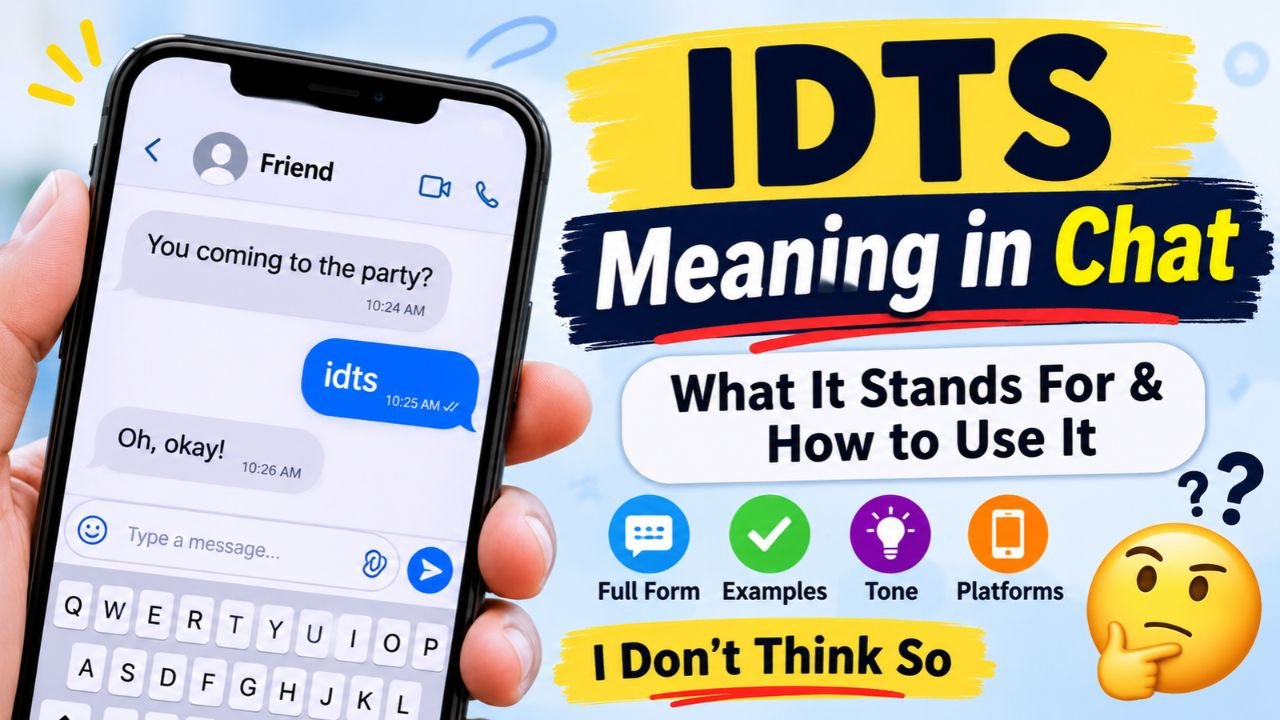
You check your chat messages and find a single message saying “idts.” No emoji, no explanations, nothing but 4 letters in lowercase. Is the sender annoyed? Being sarcastic? Or are they trying to say “no” in the politest way possible? If you’ve ever received a message of this kind and had no clue about how to interpret it, then you are not alone. The idts meaning in chat is pretty straightforward and, at the same time, ambiguous and tricky. In this guide, you will learn idts meaning in chat, where the abbreviation fits among other texting abbreviations, how the tone of the message can change the meaning of idts, and finally how to respond if you receive it from someone.
IDTS Meaning in Chat
The abbreviation IDTS means “I don’t think so.” This is what IDTS meaning in chat refers to in any messaging application, social media post, gaming chat, or group message. It carries a tone of uncertainty, a hint of disagreement, or a soft refusal to say no.
There isn’t any other widely accepted interpretation of the abbreviation in regular conversations. If you see IDTS in an academic paper or a professional setting, you will have to rely on relevant context; however, in casual talks, IDTS means the same thing everywhere.
This abbreviation is used in the same manner as LOL or BRB. Using letters instead of typing four words is much faster and easier.
Let’s consider the letters of this abbreviation to make it clear how to remember its meaning.
Breaking Down the Letters
Looking at the abbreviation letter by letter makes it easier to remember.
- I stands for “I”
- D stands for “don’t”
- T stands for “think”
- S stands for “so”
“Idts” is short for “I don’t think so.” The apostrophe in “don’t” has been removed because it is a common practice when typing out text messages. As far as “idts” meaning in chat setting, that is the only thing; however, how users of “idts” utilize it can provide additional meaning.
How People Use IDTS in Everyday Conversations
The most frequent use of these short responses is when someone makes a recommendation, assertion, or asks a question. Several typical scenarios illustrate how these types of responses function.
- Respond to a claim. Your friend tells you that a certain team will definitely win their weekend game. You say “idts” as a way to express your skepticism, without being argumentative.
- Declining an invitation. A person asks you if you can meet with them for a night out. When you say “idts, early start tomorrow,” this implies that you will most likely not be able to attend, but also includes a brief explanation as to why.
- I don’t believe so. A polite response when a group is discussing if a story is real or fake is “I doubt it.”
- Joking around. Between close friends, this type of teasing can appear as exaggerated boasting.
In all of the examples, the “idts” meaning in chat will remain the same. The only thing that changes is the context in which it’s used.
How Tone Changes the Feel of IDTS
IDTS is short enough that its interpretation can vary greatly based upon how it is capitalized, punctuated, or modified with additional words. The way in which IDTS is interpreted is one of the main factors used by people when trying to determine the IDTS meaning in chat during actual conversations.
| Version | Typical Tone |
| idts | Casual, neutral |
| IDTS. | Firmer, slightly blunt |
| idts lol | Playful |
| idts 😂 | Joking or sarcastic |
| idts 🙄 | Dismissive |
| idts, sorry | Soft and polite |
| idts tbh | Honest and direct |
A lowercase “idts” with nothing else usually reads as relaxed. A capitalized “IDTS” with a period after it can feel sharper, almost like closing the topic. Softening it with “sorry” or a reason will help soften the blow. Emojis do most of the emotional work, which is why the same four letters can be friendly in one thread and cold in another.
IDTS on Different Platforms
In general, idts meaning in chat is the same across all apps; however, the way in which it is used varies.
In text messages or WhatsApp, it seems to pop up as a one-word response in a personal exchange.
In Snapchat or Instagram direct messages, where speed and informality are most important, IDTS can appear with a smiley face.
On TikTok or Instagram comments, it is an effective way to counter a claim in a post.
In gaming chats, it is used to show disbelief in someone’s boastful claim—such as “I can win this game no matter what.”
In each instance, the shortcut accomplishes the identical purpose. It signals uncertainty rapidly, allowing the discussion to proceed.
IDTS vs Other Texting Abbreviations
IDTS is part of the “I don’t…” group of abbreviations, which can be confusing at times. This is what makes them different.
| Abbreviation | Meaning | What It Signals |
| IDTS | I don’t think so | Doubt or disagreement |
| IDK | I don’t know | Uncertainty |
| IDC | I don’t care | Indifference |
| IDT | I don’t think | Often an unfinished or shortened thought |
| IMO | In my opinion | Introducing a personal view |
| TBH | To be honest | Candid statement |
The main distinction is that IDTS has an opinion. IDK admits there is some level of ambiguity, and IDC does not care; however, IDTS states that you tend to disagree with “no.” Therefore, it may seem more polite than saying “no” directly, yet it allows you to clearly express what you think.
Also Read: PMU Meaning | ISO Meaning Slang | YN Meaning Slang
A Common Typo: LDTS
You will frequently see ‘LDTS’ instead of ‘IDTS’ due to the proximity of the L and I keys on many keyboards. For the most part, this is simply a typo. When you receive a message containing ‘LDTS’, the best thing to do is assume that the sender was trying to use ‘IDTS’ and meant the exact same thing.
Common Misunderstandings
There are a couple of errors to remember about this abbreviation and its meaning.
Thinking of it as ‘I do think so’. The abbreviation appears to be comparable to this phrase; however, the third letter of it represents the word ‘don’t’. If interpreted incorrectly, it will lead to a different meaning of the whole conversation.
Not knowing that it’s neutral. When used separately, IDTS is not rude. It may sound cold when it’s sent without any clarification and softening. Yet, with the context given, it becomes communicative again.
Believing that it depends on the sender. The idts meaning in chat does not change depending on the type of person who uses.
Example Chats Showing the IDTS Meaning in Chat
When we see the abbreviation in real-world discussions, it’s easier to understand what the idts means when we’re chatting. Below are three quick examples.
Example one: scheduling Friend: “Are you available after work tonight?” You: “idts, I’m very tired. Let’s meet tomorrow?”
In this case, the term is used as a delicate refusal along with an immediate alternative.
Example two: an audacious prediction Friend: “This new smartphone will be sold out within an hour.” You: “idts 😂 they always restock.”
The smiley emoji transforms the reply to be more playful rather than a strict refutation.
Example three: an instant correction Classmate: “The deadline is tonight, correct?” You: “IDTS. It is rather on Friday.”
This option seems more direct because it includes both the use of capital letters as well as the addition of a period. This is an appropriate choice for correcting facts. All three options maintain the same IDTS meaning in chat. The difference among the three is how each is expressed.
How to Reply When Someone Sends IDTS
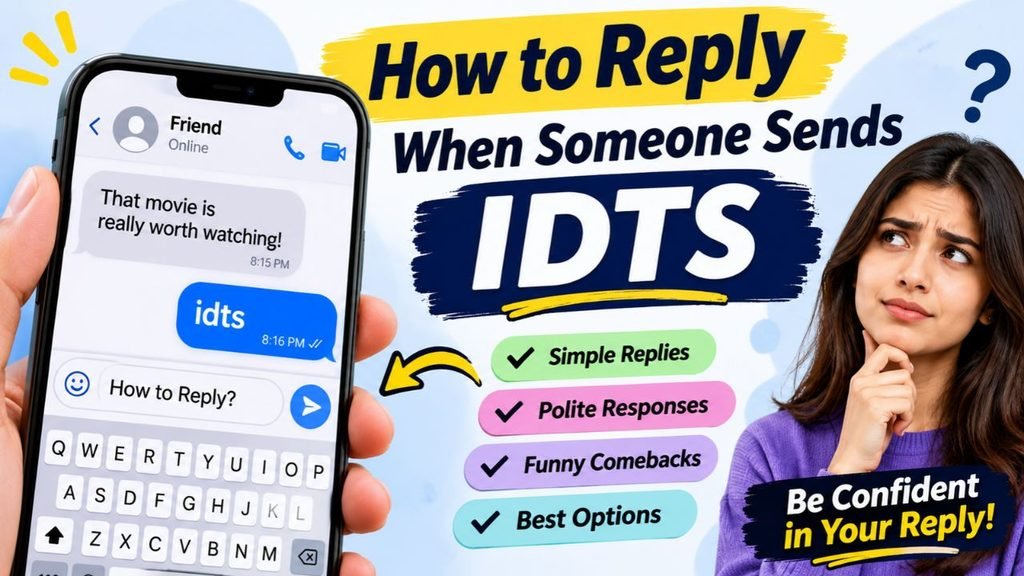
If an IDTS message is received by you, then the appropriate action will depend upon what you sent to the recipient and what your feelings are toward the situation.
If you have made a recommendation and they have rejected it, then you can handle it well by stating “No problem; hopefully next time.” If you have stated a fact and they are skeptical of your statement, then you can provide proof or inquire as to why they are skeptical. Finally, if you are uncertain of their tone, it is perfectly acceptable to inquire about their tone. In general, asking “What causes you to feel that way?” will help clear up any confusion quicker than overthinking the acronym.
When reading the first few sentences of a chat, remember that it was written to be short. Reading more than what is there can make you worry about things that are not true; therefore, read the entire exchange to see what the other person might be feeling.
When Not to Use IDTS
When you have a handle on idts meaning in chat, you will also be able to tell if using it would be appropriate. If you are communicating professionally or formally, like sending an email to a supervisor, sending a message to a teacher, or talking to a customer, then writing out “I don’t think so” is the better choice. Using texting shorthand could come off as too informal or dismissive in those situations.
In addition, it would be beneficial to avoid using this word during times when an individual is expressing their emotions or seeking assistance in a genuine manner. A single-word response may appear to be insensitive to the other person, although it was not intended to be so. A complete sentence will provide the opportunity for you to use gentler language.
Why Shorthand Like This Keeps Spreading
Abbreviations such as “IDTS” (I Don’t Think So) are used because chat is quick. People may be using a smaller screen, sending multiple messages, and/or answering other people’s questions while completing another task. Shortened terms require less physical activity and create a common language among members of a group. By understanding “idts” meaning in chat, you will be able to follow the conversation more quickly and answer using similar language.
Shorthand is based on common knowledge. A person’s lack of knowledge regarding an abbreviation used by another may result in miscommunication. In such cases where there is a lack of familiarity with the other individual, a few additional words will reduce the potential for a misunderstanding.
A Quick Tip for Learning New Slang
If you wish to remain current with abbreviations such as this, the best way to do so is to observe their usage during actual conversation, as opposed to memorizing a list. Pay attention to who sends the abbreviation, the surrounding text, and the reaction of others. Eventually, you will begin to understand the tone of the abbreviation, as well as its meaning, and this is what will allow your chat to feel more like a natural conversation and less like a confusing experience.
Also Read: MBN Meaning | WBY Meaning | HBD Meaning Slang
Conclusion
The “idts” meaning in chat is simple: “I don’t think so.” This is used as a form of expression of doubt, a mild form of disagreement, or a gentle refusal in an informal setting. The real skill is being able to interpret the tone. Lowercase letters and few punctuation marks indicate a more casual response. However, capitalized letters, periods, or even a dismissive emoticon may create a different atmosphere. Use this for casual conversation. If you need to express your thoughts clearly, take the time to write out your thoughts. You will then have no problem understanding and using this short form of communication.
FAQs About IDTS Meaning in Chat
1. What is the meaning of IDTS when texting?
IDTS stands for “I Don’t Think So.” It is popularly deployed in written communications when someone wants to convey doubt, disagreement, or politely decline an offer.
2. Is IDTS a negative or positive answer?
IDTS is normally a negative opinion or uncertainty about something. Nonetheless, its meaning may vary depending on the tone, which may be casual, fun or polite.
3. Is IDTS used on Snapchat?
IDTS is an acronym for “I Don’t Think So” and is mostly used by individuals in their chats or responses when showing disagreement or doubt over anything.
4. What is the difference between IDTS and IDK?
IDTS is an acronym for “I Don’t Think So” while IDK denotes “I Don’t Know.” IDTS shows someone is doubtful or disagreeing with something, while IDK shows a lack of knowledge.
5. Is it possible to use IDTS in workplace communication?
IDTS is seen as informal texting slang. It is better to use full phrases like “I don’t think so” in the workplace.