
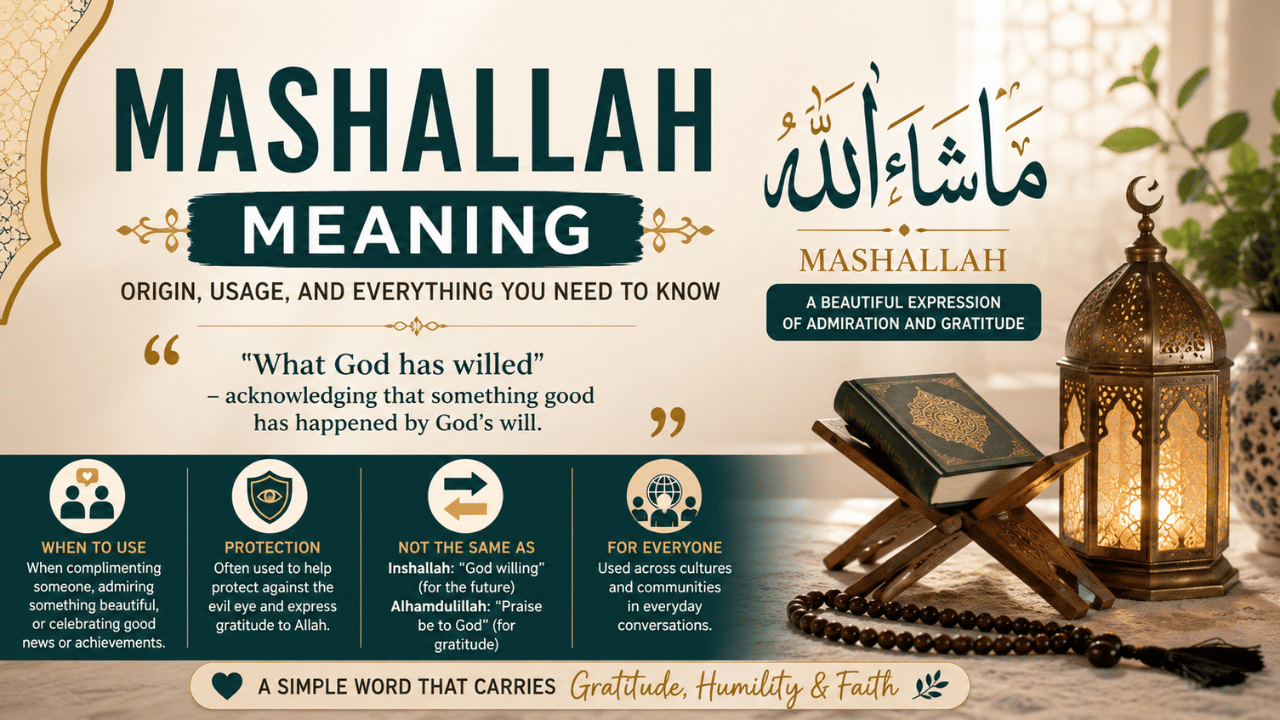
If you have spent time around Muslim communities, snuck a few international shows into your media diet, or scrolled through social media captions, odds are you’ve encountered the word “mashallah. Which is that comment that pops up when someone posts a picture of having a new baby, or an achievement, or just spotlights something pretty. By knowing the mashallah meaning, not only do you discover what it literally means, but also what the cultural and spiritual reason people say this term in the first place.
This post explains the mashallah meaning: the origin of it, literal and spiritual sense, common use cases where it’s used, plus some of the most popular questions asked about it.
The Literal Mashallah Meaning
The term mashallah (Arabic: ما شاء الله, mā shāʾa llāh). In English, it is often transliterated as “mashallah,” “masha’Allah,” or “ma sha Allah” referring to the same phrase. Literally translated, it means God has willed / what god has willed.
Mashallah meaning, at its core, is an acknowledgment that something good, beautiful, or fortunate has taken place, but it only happened because of God’s will and not due to sheer human effort or careless happenstance. A combination of thank you, humility, and a higher note in the form of credit for the thing that has gone well instead of just churning your own achievements.
Source of the Mashallah Meaning & Phrase
This phrase has a deep history within Islamic tradition and appears in the Quran itself, in a verse where it is recommended to acknowledge God’s will when encountering something impressive instead of being arrogant about it. The term grew, over centuries, into a spontaneous, quotidian expression amongst Muslims the world over and then seeped into general usage among many Arabic speakers alike – irrespective of an individual’s actual performative religion.
Given Arabic’s long history of cutting across linguistic and cultural traditions in much of the Middle East, North Africa, South Asia (and beyond) within predominantly Muslim regions, mashallah meaning usage extended far beyond religious-themed contexts to become a mainstay among everyday exchanges between many communities.
What is the Reason Why People Say Mashallah
Knowing when and why this phrase is said is just as important or even more than simply knowing how to translate it word for word! The most common situations when you will hear it regularly are in
Expressing Admiration or Praise
This is the most common usage: when we compliment someone on their beauty or heroism, an artwork, an achievement, even nature! To say mashallah when admiring something is an expression of understanding that the beauty or success in what you’re praising exists by the will of God (swt).
Protecting Against the Evil Eye
In many Islamic cultures, one hears about the “evil eye,” which is an evil that comes from jealousy (even if unintentional). When we say mashallah while complimenting someone, especially children, we help to prevent this negative energy by immediately attributing it all to God and not allowing pure human admiration or envy to go unchecked.
Reacting to Good News
This comment is used when someone has shared good news about a new job, a pregnancy, an engagement, or any other milestone, and responding with this appraises their perfectly lucky state while expressing authentic happiness for the other party.
Marveling at Nature or Creation
It is often used when witnessing something naturally impressive, such as a sunset, expansive landscape, or sunrise, and is therefore perceived as God’s creation nascent in the world; that is an appreciation of existence.
Also Read: Sober Meaning | Submissive Meaning | IMK Meaning
Common Situations Where You’ll Hear It
| Situation | Example Usage |
| Complimenting a baby or child | “Mashallah, she’s grown so much!” |
| Praising an achievement | “You got the job? Mashallah, congratulations!” |
| Admiring appearance | “Mashallah, you look wonderful today.” |
| Reacting to good news | “You’re getting married? Mashallah!” |
| Appreciating nature | “Mashallah, what a beautiful view.” |
Mashallah Meaning And Similar Islamic Expressions
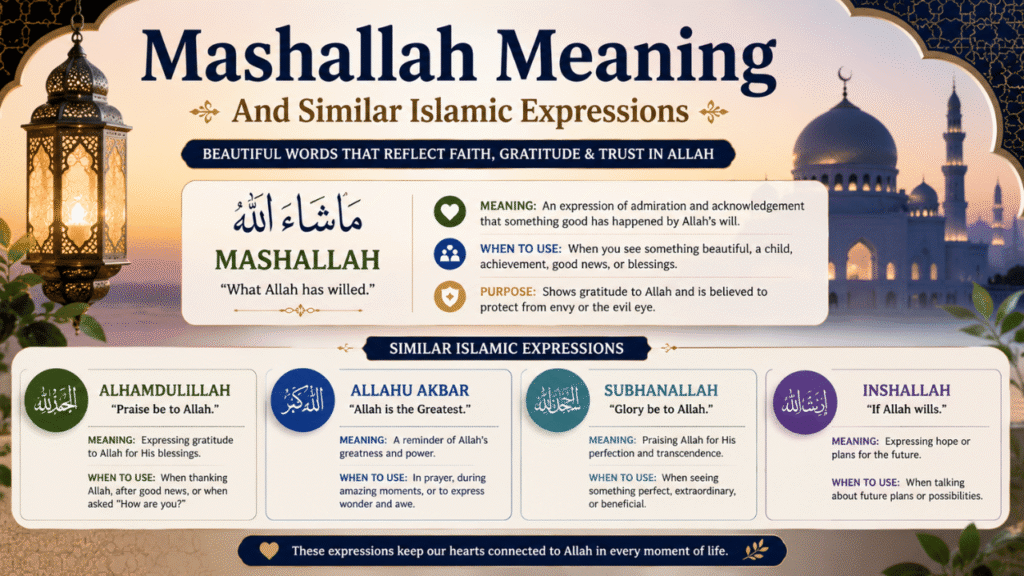
Since many Arabic slang expressions are integrated into everyday speech, it’s thus very easy to mix them up if you’re not aware of the context of each word.
Mashallah vs Inshallah: While mashallah acknowledges something that has already happened, “inshallah,” which means ‘God willing,’ is only used when speaking about things hoped for or planned in the future. You might hear someone say, “I will see you tomorrow inshallah,” hoping that the arrangement goes ahead – that’s a very different role to what mashallah means.
Mashallah vs. Alhamdulillah: “Alhamdulillah,” like its best, should be used to express gratitude related to something, or as a response of how you are doing nowadays or when the blessings come up, for instance when someone says something such as ‘Mashallah so depicted on and we need to be worry free can not get it.’ Both relate to giving recognition to God in the case of the positive events; however, mashallah is more specifically focusing on expressing admiration and praise for where there are some impressive things or events, and alhamdulillah is referring to general gratitude.
Mashallah vs Subhanallah: “Subhanallah,” which means “glory be to God,” is often said when something unbelievable happens or simply in disbelief. It has a different connotation than mashallah, which is more specifically about praise linked with admiration.
Is Mashallah Limited To Muslims?
Although it is an expression that stems from Islamic tradition (and is still used mostly by Muslims), in many areas of the world, its cultural influence goes beyond Muslim circles. The phrase is sometimes used in a casual manner among those of diverse commitment paths in countries and communities with deep Arabic linguistic impact, the way phrases from one religion can become embedded into the everyday language of multiple cultures over time. That said, although the term may seem more meaningful and have its practical use among us all now, it is still used mostly in religious and cultural contexts.
Understanding the Meaning of Mashallah When Using It
If you’re new to the phrase and want to use it wisely, some general rules are useful in making sure that you benefit from it without being offensive. It’s best when used genuinely, in an instance of real admiration or recognition of luck and not sarcastically or as a fad sentence. Because the word has real religious and cultural significance for many people, speaking thoughtfully about it rather than casually impersonating powerful sounds without understanding is respectful to the meaning behind the word.
When in doubt about whether the phrase is appropriate (or get a peek at its natural usages) ask those around you how to use it for yourself, and honestly, that way respects the whole situation.
The Practise of The Mashallah Meaning in Today’s Life
Although the term was originally rooted in religion, this saying has branched into contemporary digital culture, showing just how adaptable and lasting the expression can be. In social media, the word is often used under photos of children, weddings, new homes or personal accomplishments – just one natural way to spread good news publicly while maintaining its original spiritual meaning.
Likewise, until quite recently, music and pop culture around the globe have exposed a wider audience to the term than many even realise its religious significance. The more widespread exposure of the term has sometimes allowed it to be used in a more relaxed or colloquial manner than its more traditional usage might seem to suggest, which is why anyone who hopes to use the word mindfully should seek an understanding of the bigger mashallah meaning rather than just picking up the word through passing exposure.
It is also what we use to describe the expression inside families and closer communities, often repeated through generations – grandparents complimenting on grandchildren or friends celebrating each other. It is this generational continuity that helps keep the expression, even as it branches out into wider, more mainstream usage around the world, feeling personal and earnest.
Also Read: FT Means What | IRL Meaning | Bougie Slang
Final Thoughts
Essentially, mashallah meaning is more than just the literal phrase representation of “what God has willed. It is an analogue of a subtle cultural/ spiritual practice where everyone swears to a higher power, mainly in moments of awe, gratitude & fortune and it is therefore protective and humbling in case of envy and arrogance. Whether you hear it toasting a friend’s success, enjoying a scenic view, or praising a newborn child, insight into the purpose behind this short phrase layers actual significance upon a small but significant sliver of daily human experience for hundreds of millions around the globe.
Frequently Asked Questions
1. Why do people say mashallah before inshallah?
No. Mashallah is an expression of praise for what has already happened; inshallah (also spelled as “insha’allah”) means, God willing, or if God wills that will happen later on.
2. Can non-Muslims say mashallah?
Yes. Although it has origins in Islam, this is also used with respect by people of other cultures.
3. Do we only use mashallah in religious contexts?
No. It is commonly used in dayto-day dialogue to show approval or appreciation.
4. What is the difference between mashallah and alhamdulillah?
Mashallah reflects a sense of admiration and alhamdulillah means “praise be to God” and depicts thankfulness.
5. Can we say mashallah in the casual manner?
Yes, as long as they are used respectfully and honestly for their cultural and religious significance.