
If you are writing and you have stopped to yourself saying, “Is it pacient or patient? You are not alone. This is one of the more frequent spelling confusions among English learners, and it’s easy to see why: in many other languages, this word, spelled with a “c” instead of a “t,” refers to this exact concept. That tiny difference makes a world of difference, particularly for bilinguals/multilinguals.
That begs the question: the good news is that this question has a clearly defined, simple answer. Let’s go through why patient is the right choice here, why pacient confuses so many people, and how you can be sure of never getting confused between the two ever again.
The Quick Answer
There are two correct spellings of “patient” but only in standard English. None of the English dictionaries (Merriam-Webster, Cambridge, Oxford, etc.) has a word like “pacient”. If you are one who has written “pacient” it is worth correcting that habit immediately, because this spelling of the term is wrong regardless of the context in which we use it (in a medical report; by mail, in an essay or message).
So every time the pacient or patient question comes up, it is not so much a matter of taste – nor even any regional difference. It’s a straightforward case of spelling it right vs wrong in English.
Why Does This Confusion Happen?
In essence, why so many people write “pacient” instead of “patient” boils down to the influence of other languages. In Portuguese, Spanish, Romanian, and many other Romance languages, it is spelled with a c: paciente in Spanish and Portuguese, pacient in Romanian, etc. These words all contain the same Latin root as the English word patient but took a slightly derailed course of spelling through centuries past.
To a native speaker of one of these languages, or to anyone who grew up hearing and reading the spelling with “c,” it is perfectly instinctive to transfer that spelling into English. This is such a common cross-language kind of spelling slip; it occurs not just with this word pair but with plenty of others too. That’s not because you have terrible English; it’s just a classic symptom of languages that can look and sound very similar.
Grasping this origin makes the error much easier to spot and correct, since if you know that English opted for the ‘t’ (the letter) but many other languages kept the ‘c,’ then it becomes very easy to be aware of your writing in English specifically.
Where Does “Patient” Come From?
The English “patient” and its Romance-language cousins ultimately derive from patiens, the present participle of pati-, Latin for to suffer or endure. That root helps explain the two meanings of the word (or rather, its two lexical forms) as it exists today: the adjective that describes someone bearing hardship calmly and the noun describing someone receiving medical care, as historically speaking, one was long a function of the other, where being sick or being treated came with the implication that you would then be subject to suffering.
Due to Latin spreading among the different European branches, separate spelling conventions for each branch have emerged. French, which strongly influenced the Oxford English Dictionary after the Norman Conquest, landed on patient with a “t” from Latin and drifted into English with that spelling. Because Spanish, Portuguese, and Romanian developed along separate paths from Latin, however, they have forms much closer to the original “c” sound in that syllable. And this is precisely why we have the two word forms in the first place – not by accident of our modern times (for instance, through trying to exert some effort in anglicizing business terms) but instead because centuries of linguistic divergence have taken place.
Also Read: Seal vs Seel | Hussle vs Hustle | Girlie or Girly | Eventhough or Even Though
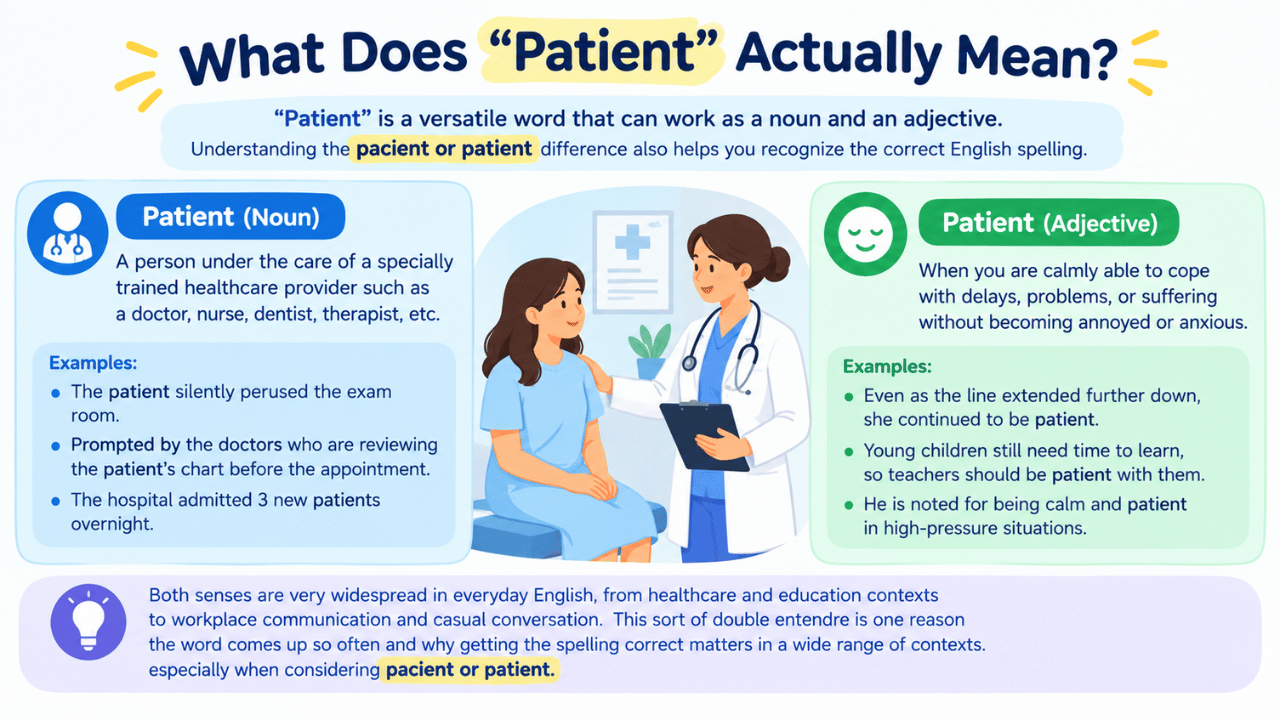
What Does “Patient” Actually Mean?
“Patient” is a truly versatile English word that can work as a noun and an adjective, so you must understand both uses clearly. Understanding the pacient or patient difference also helps you recognize the correct English spelling.
A patient (noun) is a person under the care of a specially trained healthcare provider such as a doctor, nurse, dentist, therapist, etc.
- The patient silently perused the exam room.
- Prompted by the doctors who are reviewing the patient’s chart before the appointment.
- The hospital admitted 3 new patients overnight
Patient is when you are calmly able to cope with delays, problems, or suffering without becoming annoyed or anxious.
- Even as the line extended further down, she continued to be patient.
- Young children still need time to learn, so teachers should be patient with them.
- He is noted for being calm and patient in high-pressure situations.
Both senses are very widespread in everyday English, from healthcare and education contexts to workplace communication and casual conversation. This sort of double entendre is one reason the word comes up so often and why getting the spelling correct matters in a wide range of contexts, especially when considering pacient or patient.
When is Pacient Ever Correct in Any Context?
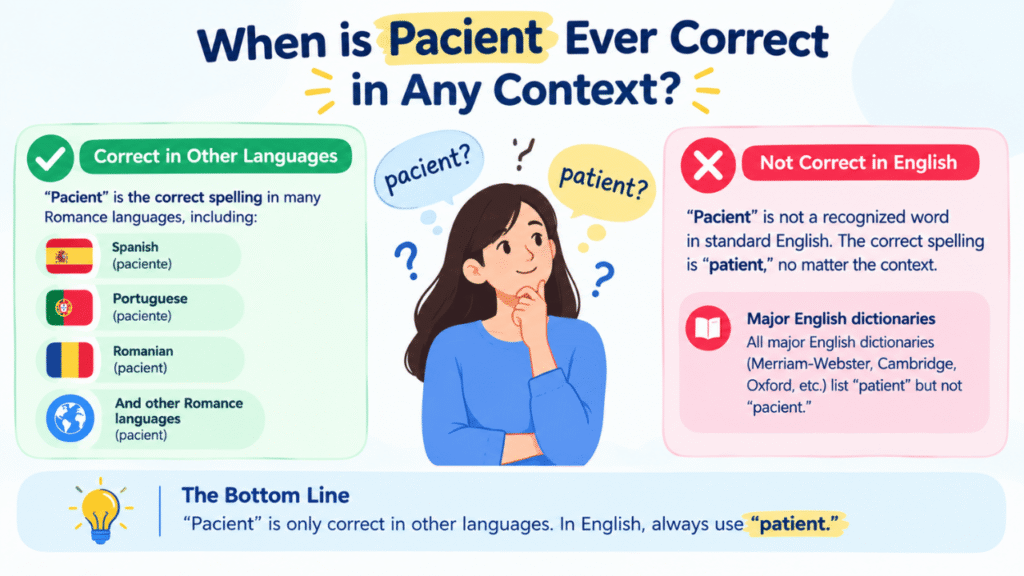
Outside of English, yes, absolutely. Whilst if you are writing in Spanish, Portuguese, Romanian, Catalan, or a whole host of other Romance languages, naming this concept with a “c” is perfectly right and even to be expected. This confusion only happens when that spelling is transferred into written English, where it is incorrect. Understanding the pacient or patient difference is important when switching between these languages.
And it should be added that “pacient” is not a slang term, or a spelling in a regional dialect of English, nor an acceptable informal variant, as some other pairs of words might actually have a valid alternative form based on British vs American. This isn’t that sort of thing. But “Pacient” is simply a different language, and using it in English writing is just spelling it wrong, not some grand stylistic vision. The pacient or patient distinction therefore depends on the language being used.
Common Mistakes to Watch For
Because this confusion is so intrinsically associated with linguistic background, it tends to appear in pretty predictable ways. A couple of other things that are worth noticing.
Medical and healthcare writing. Because “patient” is such a prevalent term in the medical world, this grammatical mistake can pop up all over clinical notes, healthcare forms, and even the content of medical blogs when written by multilingual authors or inconsistently translated.
Academic and professional writing. This sometimes leads learners of English to carry this way of spelling into essays, reports, or emails – especially when they are under pressure: They will not be able to check as easily.
Autocorrect gaps. If you have a spell-checker that has been set to another regional language or perhaps even a multilingual keyboard, this instance of “pacient” will most likely pass the spell-check unnoticed.
Assuming it’s a stylistic variant. Some writers sincerely think that “pacient” could be a parallel or pre-modern English spelling when, in fact, it never even was part of standard English at any time in its history.
If you know how to proofread your writing, this is a mistake that can easily go unnoticed yet erodes the overall quality of your piece.
Simple Trick to Recall Proper Spelling
Here is a simple, easy memory trick to forever end the pacient or patient debate: have in mind the word “patience,” which is the noun that describes having that quality of being capable of waiting calmly. Patient or patience both share the same “t” spelling, but also have the same root! The root is the same, so as long as you know how to spell “patience” correctly, most English speakers do this instinctively; then you’re halfway there because “patient” is made of the same stuff.
Another useful association is the association of “patient” with other common English words that are also in “-tient” or “-tience,” where you reinforce that even among its Romantic language relatives, English consistently favors the “t.”
Why This Distinction Matters
It may seem trivial, but spelling and grammatical accuracy really does make a difference to the level of professionalism of your writing – especially if you are working within an industry where the word ‘patient’ appears on every page, such as healthcare, education, or customer service. Other common misspellings, such as “pacient” in a medical report or professional communication, can be acceptable to readers – they may question why a writer does not paint the picture of her remarkable depth of knowledge or skills but never doubt that she is competent at her job. Understanding the pacient or patient distinction can help writers avoid this common spelling mistake.
This is a confusion point that multilingual writers should know about in the pursuit of better and more confident English writing overall. Awareness of which words are likely to be subject to this type of language transfer error allows you a much easier chance at catching and correcting them before they become second nature. Knowing the difference between pacient or patient is one simple step toward more accurate English writing.
Also Read: Roster or Roaster | Comming or Coming | Planed or Planned
Conclusion
The pacient or patient dispute is simple and has one rule: “patient” in English with a “t” is the only proper form, while the word “pacient” belongs to languages like Spanish, Portuguese, and Romanian. The two words are from the same etymological family with a Latin ancestor, but centuries of separation between their respective languages meant that English followed a different spelling route.
Once you realize where the confusion stems from and relate “patient” to the more common word “patience,” this is another spelling query you will never again have to look twice at.
FAQs About Pacient or Patient
1. Is Pacient ever correct in English?
Pacient isn’t an actual English word. The correct spelling is “patient.”
2. Where does “patient” come from?
It derives from the Latin patiens, which means “to suffer” or to endure.
3. Did you know “pacient” is British or American?
No. “Pacient” is wrong in both British and American English.
4. How do I memorize the right way to spell it?
Think of “patience.” Even “patient” and “patience” share that “t” spelling.
5. Does “pacient” appear often in medical writing?
Yes. This can occur in medical writing, especially from multilingual or translated material.