
Of all the grammar questions that crop up more than once in day-to-day writing, rarely do you get a debate as persistent as eventhough or even though. This confusion is found everywhere you look, from the simplest of emails to lengthy essays, in text messages, and even in published content on the web-largely due to how seemingly ubiquitous its misspelled counterpart has become that many authors actually consider it an acceptable alternative. In this post, we’ll answer that question definitively, explain why it often gets confused, and provide some rules of thumb for getting it right each time.
The Correct Answer
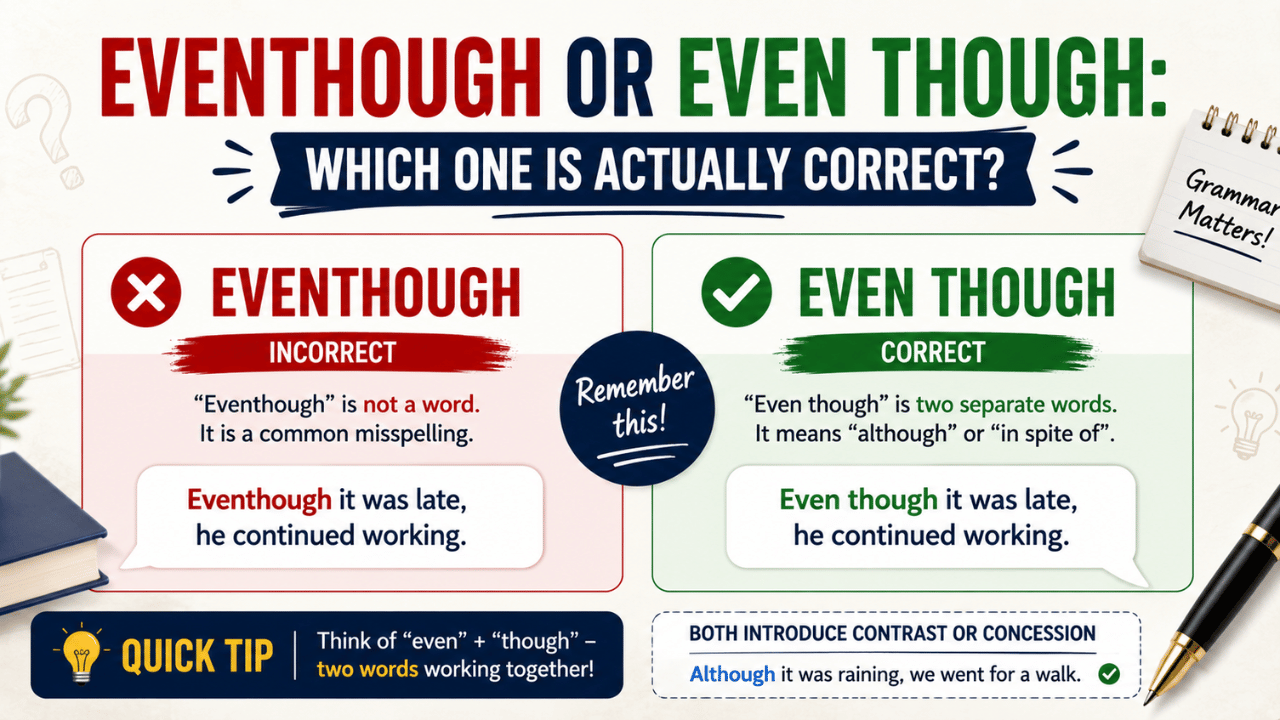
Now, without further ado. Eventhough vs Even though: The right Version is always two Separate words in legitimate dictionaries; you will not find the one-word version: eventhough. Regardless of the type, whether a formal essay, a casual text, or a professional email, when a combination of these two words is required, you should write it in its two independent parts: “even” + “though”.
If you ever stop during writing to ponder whether you should be spelling eventhough as one word or two, stop doubting yourself. In standard English, the only acceptable form is two words.
Why Does This Mistake Happen So Often
The reason that so many people confuse eventhough or even though with is pretty simple: the familiarity of other compound words in English. There are also many valid single words in English that are simply a combination of two smaller words (although, anyway, nevertheless, moreover). It’s a logical mistake, because these compound conjunctions are quite common, so to me it’s natural to think that the combination “even though” follows the same rules, and thus many German students tend to merge them into one single word.
But “even though” just never followed that journey with the words. In contrast to “though,” which for centuries has fully coalesced into a single word, “even” and “though” have always remained isolated, two independent words acting as one organism closer in function to a phrase than a compound.
Even Though vs. Although: Why the Confusion Is Understandable
One of the reasons that eventhough or even though is such a stubborn error is its close affinity with although, an almost exact grammatical and functional twin, which unambiguously should be written as one word. These two phrases are used to introduce a contrast or concession as part of a sentence, so they can often be swapped for each other.
| Phrase | Correct Form | Function |
| Even though | Two words | Introduces contrast or concession |
| Although | One word | Introduces contrast or concession |
| Eventhough | Incorrect | Not a recognized word |
Therein lies the reason as to why some writers, perhaps mistakenly, assume both phrases can be treated as a single word because “although” is a single word and functions almost exactly like “even though.” This functional overlap is probably one of the largest hidden sources for when a person mixes up eventhough and even though.
How “Even Though” is Actually Used
By exploring each word independently, one can even understand why the two sequential words version is accurate. In this case, “even” serves as an intensifier – it emphasizes the contrast being expressed, while “though” operates as a subordinating conjunction that introduces a subordinate clause contrasting with the main idea of the sentence. When you add these two different words together, they create a phrase that provides an anomaly.
This is how a few examples of sentences using even though are right way.
- “Even though it was raining, we decided to go for a walk.”
- “She finished the marathon even though she had injured her ankle.”
- “He remained calm even though the situation was stressful.”
For all three of these examples, the contrast that even though conveys between two ideas is exactly what this phrase serves to do.
Also Read: Roster or Roaster | Comming or Coming | Planed or Planned
Common Situations in which this Mistake Appears
As eventhough or even though the misunderstanding is frequently seen in rapid-fire informal writing, wherever less is spent editing than proofing earlier to throwing down a draft or sending a message. A few common examples include:
- Text messages and casual chats (“Eventhough I’m tired, I’ll come”)
- Social media captions and comments
- Quick work emails typed in a hurry
- Early drafts of essays or articles before proofreading
- Online forum posts and comment sections
This phrase can easily slip into our writings people say so often casual as well as in formal writing but worth a double check for professional and academic settings like essays, reports, or business communication where this specific mistake may be more conspicuous than a quick text message exchange.
Use Simple Techniques to Help You Spell it Right
If you often stumble over eventhough or even though, a couple of mnemonic devices can cement the correct version into your brain.
- Now Split those two words. Tell them that “even” is its own isolated intensifier and “though,” on the other hand, is an independently functioning conjunction; two codependent words making baby steps into each others’ territory but never forming one.
- Compare it to “even if.” Because “even if” is written without hesitation as two separate words (as the literal interpretation would suggest), recall that this pattern also applies to “even though,” which keeps them apart.
- Don’t let “although” influence you. Even though they have a comparable grammatical usage, consciously remind yourself that “though” and “although” are different phrases with varied spelling rules.
- Read your sentence slowly. Pausing to say “even though” as two separate beats when you write or read back your sentence will reaffirm the separation and help.
- Use spell-check as a backup. Your typical modern spell-checker will flag “eventhough” as an error, which provides a helpful safety net if you would type it out of habit.
Other Two-word Phrases That Can Have a Similar Effect
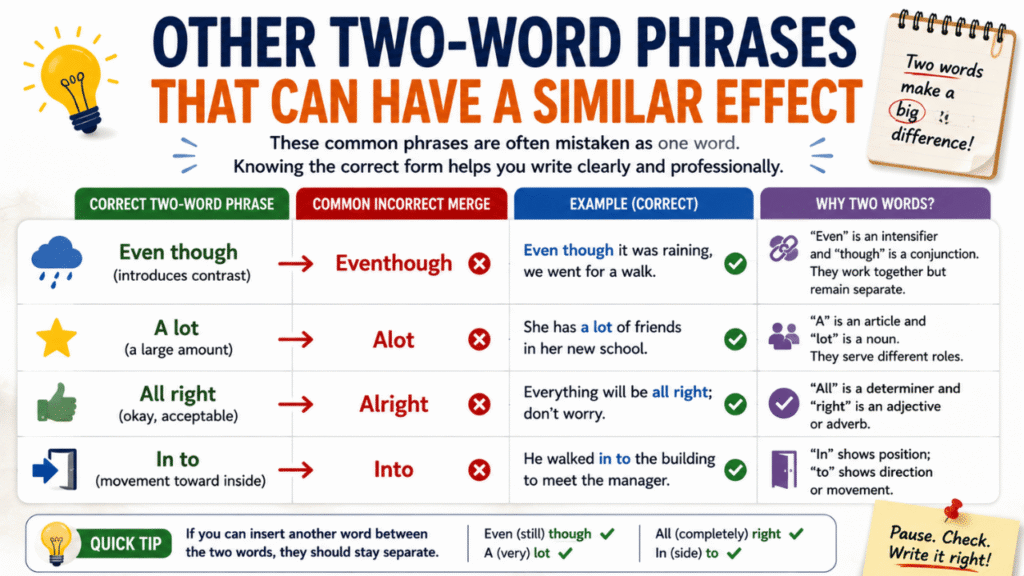
The eventhough or even though error is not a stand-alone case. There are a number of other two-word phrases in English that make this mistake: they get written as one word, usually owing to their similarity to established compounds.
| Correct Two-Word Phrase | Common Incorrect Merge |
| Even though | Eventhough |
| A lot | Alot |
| All right | Alright (debated, though increasingly accepted informally) |
| In to | Into (context-dependent, sometimes correctly merged) |
Because you can see eventhough or even though is in this larger, well-documented category of phrases that are frequently combined incorrectly, this makes the error less frustrating and becomes less of a feeling of being bad at writing – but more like being one of many who grew up saying these things.
Does Autocorrect Always Catch This Mistake?
The answer, in most of today’s word processors, smartphones and a good deal of web browsers is yes; because “eventhough” is not a valid English word, autocorrect would generally object or automatically correct as soon as it is typed. The fact that built-in spell-check support plays a larger role today has made the eventhough or even though mix up feel less like day-to-day battle for many writers than it was in decades past.
On the one hand, autocorrect is not available in every writing environment, particularly certain messaging apps, specialized software or handwritten work. Realizing the proper spacing on your own instead of depending entirely on something that can easily be auto-corrected is still a genuinely useful skill to have for anyone regularly writing in professional and academic environments where spell-check may not always be present or reliable.
Why this Still Matters so Much
Although it might sound like a minor point, but when you choose between eventhough or even though in there sentence correctly each and every time has been useful to your writing style especially in professional academic locations. A single spacing error is not going to destroy a paper that is otherwise solid, but repeated foolish errors can give the reader an impression of perfunctory writing even when the underlying writing and logic are very strong.
By examining why “even though” is two words and not one, we also boost our grammar confidence in a broader sense– the better you’ll be equipped to manage other phrases you deal with in your writing.
Double Check Yourself in Quick Manner
If you’re ever in doubt when writing and need a quick tip to help you decide whether it’s eventhough or even though, try thinking “what would happen if I change the word to although?”. If the sentence works with although, you know that this has to be a phrase introducing contrast in which case even though, written as two words, is also correct for the same kind of function.
Also Read: Bearly or Barely | Spell Calendar | Meaning of Jordan
Conclusion
As for eventhough or even though the result is unambiguous: “even though”, written as two words, has only to be correct. The confusion mostly lies in the phrase’s functional overlap with “although,” a current single-word compound that operates basically as a synonym. Once you appreciate how “even” and “though” have always been distinct (divorced, even) words rather than a single spliced compound word/term, the spacing falls into place naturally as you’ve learned to apply it consistently in all your writing.
FAQs About Eventhough or Even though
1. What is the difference between “eventhough” or “even though”?
Because of how phrase acts as “although” which goes as one-phrase.
2. Does “even though” mean the same thing as “although”?
Their grammatical functions are similar and they often introduce contrast or concession.
3. Will autocorrect catch “eventhough”?
In general, yes, as eventhough is not standard English.
4. Which other expressions are usually mistaken for each other?
Yes. In this way, often we write “alot” but it’s really wrongly written because it should be “a lot” or two words.
5. Does writing “eventhough” matter?
Yes. In formal writing, it can make your work look less professional.