
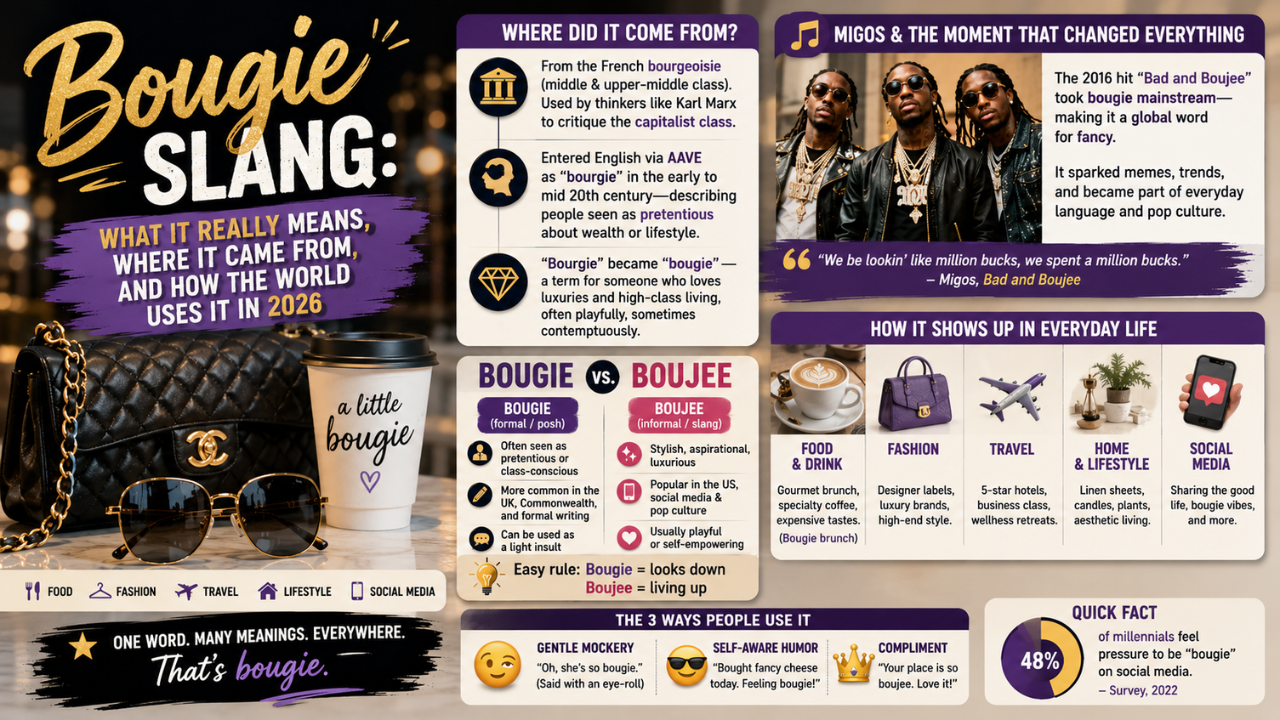
Language is a living object; it takes, it morphs, it changes direction, then bills or Migos comes out and poof. Everyone does. No word in the last ten years has gone that entire journey quite as dramatically as bougie slang. What began as incisive social critique among in-group members slowly radiated outward, softened, became a catchphrase in a Billboard-charting rap song, erupted on the dopamine-pumping megaservices that are social media, and now lives for people thousands of miles away who probably don’t know that they are unwittingly quoting French revolutionary class theory every time they call a brunch place “a little bougie.”
It gets into all of it: the word’s roots, its journey through culture, why there are two different ways to spell bougie and how the impact of that spelling changes based on who says it and to whom (and what – if anything they mean by it), plus real life examples of how bougie slang plays out in conversation, music, fashion, food, but also just plain old life in 2026.
Where Did “Bougie” Actually Come From?
The term bougie is a French derivative referencing the bourgeoisie, historically referring to the middle and upper-middle class. The English bourgeois comes from the French bourg (“town”) and Latin burgus (“fortified town”), originally meaning “an inhabitant of a fortified town” – which then extended to ”property owning” along with social status. Bourgeoisie was a term used by philosophers like Karl Marx to define the merchant class and criticise it for materialism, privilege, or, as described in Wikipedia, “the capitalist class that owns most of society’s wealth and means of production.”
When the term entered English, it meant a person with conservative, class-centric values. The term is derived from the slang term bourgie in African American Vernacular English (AAVE), which emerged in the early to mid 20th century as a description for those who were seen as pretentious for their wealth, or perceived view of themselves based on their lifestyle choices.
Eventually, “bourgie” became the contemporary spelling of “bougie,” a term that broadly captures a person who loves luxuries and high-class consumption, or an all-too-pretty-for-TV lifestyle, often playfully, sometimes contemptually.
Migos & The Making of “Bad and Boujee” – How It All Changed
Bougie had been simmering there, in a kind of slow metamorphosis through African-American vernacular for decades before one song in 2016 detonated it into the mainstream. With the 2016 megahit “Bad and Boujee,” Migos wrote lyrics that boasted of the attractiveness and sophistication of women in tandem without being snobby. This song ended up being a huge hit and helped launch boujee in the mainstream usage of “fancy”.
Search trends agree and tell us boujee really took off after Migos, ruling casual English and social media years later. The global smash “Bad and Boujee” hit number one on the US Billboard Hot 100 and remained in cultural circulation long past its pop chart run, the type of song that’s so good it creates memes, references, and parodies for years. Every time someone badgered their overpriced latte or their friend’s designer handbag as “boujee”, they were conducting a cultural moment – Migos fired it off, generally without understanding.
Megan Thee Stallion, the superstar who once rapped “you can eat my ass if you don’t like my tone,” outlined associations of the word in her own songs, opening up new possibilities for what it could mean, not merely a description of taste, but an assertion of hard won luxury and self-confidence.
The default gave a lesser spelling change from bougie to boujee in the tune title, deliberate and commanding. Boujee recently came out of hip-hop culture and social media. Boujee, which is the informal version of bougie, by contrast; you say you are boujee because you want a bit of aspiration in your life. After all, it is sending high-end vibes – sometimes jokingly so.
Also Read: IMK Meaning | IRL Meaning
Bougie vs. Boujee: Is There Really a Difference Between the Two?
This is one of the most common questions that come up revolving bougie, and the answer is more complicated than people think.
Easy to remember: bougie = formal/posh, boujee = informal/slang/fancy. The first two words are pronounced approximately alike – “BOO-zhee” but have different connotations.
The two terms are abbreviations of “bourgie,” which is short for bourgeoisie, the French word. In common parlance, the word “bougie” often comes up as a kind of insult aimed at people posting about their expensive clothes, blingy cars, and stereotypically bourgeois behaviour on social media. One of the songs that popularized “Boujee” is called [Bad and Boujee] by Migos, and it emphasizes style and confidence, giving meaning to people who make their own money.
There is also the practical dimension of that spelling question. Example: Having an audience in the US, “boujee” is where social media and pop culture contexts head. “Bougie” is generally associated with the UK, countries of the Commonwealth, and somewhat more formal writing. For any audience you may have around the globe, bougie is a more familiar and safer bet. Which is why, if you are writing a social media caption, forget “boujee” if your meaning aspires to more current or culturally sophisticated resonance. On the other hand, if you are writing an essay, article, or other formal content, bougie is the correct form.
Other spellings: – “bourgie,” – “boujie” and on rare occasions, “booji” – can be found in some corners of the internet but are comparatively less frequent than boujee and really have no standardised form (though they exist as other opinions).
What does Bougie Slang Actually Mean?
Bougie slang had originally only ever been a contemptuous term; its meaning changed in important ways, yet. It now exists within three specific territories based upon tone and context.
As Gentle Mockery
However, the critical use is as alive and well as it ever was. If someone remarks “oh, she’s so bougie,” in a certain tone with an exaggerated eye-roll, they are subtly – or not so subtly – accusing the subject of being snobby, putting on airs, and bartering more sales than she really can afford. Boujee is still a pejorative when someone is deemed to be acting above their station.
Examples:
He ordered a $22 avocado toast and whined it ‘wasn’t artisanal enough.’ So bougie.”
“They had to move over there just for snob factor. Total bougie move.”
Soft cells would be embarrassed by that; she would never travel. Way too bougie for that.”
As Self-Aware Humour
Secondly and now primarily, is fully self-serving and loving. This is particularly obvious where people define their own behaviour (spending money on taking a holiday, for example — which was the original use of bougie) with a wink: overindulgence just above standard practice and no need to feel embarrassed about it.
Examples:
At the weekend farmers’ market, I bought fancy cheese. Feeling very bougie today.”
Shortly before our trip, we stayed at a hotel with a bath menu. It was the bougie era I am living my best.”
Us when we spent £40 on scented candles and feel nothing. This is my bougie self-care.”
As a Straightforward Compliment
At this point Boujee is mainly used as a slang word that means people doing something special for themselves, treating themselves just a little better than what they’re used to. In this use, it has pretty much entirely lost its critical freight and simply provides an upscale or luxurious, even impressively fancy meaning to what follows.
Examples:
That restaurant was super ricos, I felt like royalty.
“Her wedding was absolutely boujee. Every detail was perfect.”
“Your house very bougie. I love everything about it.”
Bougie slang in almost every area of life
Kin to what keeps bougie slang so evergreen: scope. It can be used in nearly all your domains of life.
Food and Dining
Gourmet Restaurants have been called “bougie.” According to a report, research discovered that after post-order and indoor dining after the pandemic began, the number of people visiting diners began to increase by 30%, reflecting “Bougie” culture in restaurants. The term bougie is a common shorthand term for an expensive yet delicious brunch spot! The term “bougie brunch” has become a whole new social media genre in itself.
Fashion
Things with designer labels, bespoke closets, anything that carries a brand in an appointment — which was consistently named bougie. The term has become a catch basin across fashion circles for adjacent luxury regardless of price.
Coffee Culture
Arguably no one single product has grown more in tandem with bougie slang than the specialty coffee itself. You train your informant on oat milk lattes and single-origin pour-overs, minimalist cafés with exposed brick where both the coffee and drinker cost £7 to enjoy, one of our most revered cultural comedic genres: the bougie coffee order, its very own genre reviled and reveled in.
Travel
Bougie travel, which is all the 5-star hotel, business class upgrades, more thought in a location than just googling where to go, being whisked away at wellness retreats and private villa reservations. The “bougie holiday” is an entire aesthetic on Instagram and TikTok.
Home and Lifestyle
Linen bedsheets, handcrafted candles, potted plants with Latin names, charcuterie boards and sourdough starter: the domestic bunny-boo culture is an ecosystem all of its own. Bougie moments, a new hashtag that celebrates all the extravagant brunches and high-end fashion hauls.
Bougie Slang In The Time Of Social Media
Social media has spelled both the accelerant and the pressure cooker for bougie slang culture. Instagram creates bougie culture because influencers share their greyse lifestyles all day on the app. A survey in 2022 showed that about48% of millennials say they feel pressure to be “bougie” on social media, highlighting the part these platforms play in shaping perceptions.
That figure is revealing. The fact that almost half of millennials feel pressured to appear bougie online is not a measure of real wealth, but performative. And that difference between aspiration and actuality is precisely where most of the humor, and much of the relatable bougie slang content, resides. This is best illustrated through the “bougie broke” meme: someone spends money they do not actually have on experiences to feel superior, and had been one of the most widely circulated social media ideas over the past two years.
It was that struggle between an impression of wealth and a reality of poor financials that gave rise to “bougie” as the most relatable slang of 2025. This is funny in a true way for many people, and honest about that truth in its warmth instead of an edge.
Bougie Slang: A Quick Reference Guide
| Term | Meaning | Tone | Best Context |
| Bougie | Fancy, pretentious, upscale | Neutral to mildly critical | General use, writing |
| Boujee | Luxurious, aspirational, stylish | Positive/playful | Social media, casual speech |
| Bourgie | Original slang form of both | Older, slightly more critical | Conversational reference |
| Boujee broke | Splurging on luxury despite tight budget | Self-deprecating/humorous | Meme culture, relatable content |
| Bougie era | Period of treating oneself to finer things | Self-celebratory | Personal social media |
| Peak bougie | Maximum level of fanciness or pretension | Exaggerated/comedic | Social commentary |
Synonyms, Antonyms, and Related Slang
Bougie Slang: wealthy persons of high social status fancy posh elegant swanky classy upscale lavish frilly overdressed extra insatiable hot-wired high-maintenance.
Opposites: Realistic, Anna Wintour (editor of Vogue), any professional very wealthy person who understands money, basic (original definition), minimalism.
Related slang that is always getting paired up with bougie: Slay, that girl, main character energy, luxe, soft life, elevated, living my best life, treat yourself bitch bow down server bougie on a budget rich girl vibes.
How Not to Use Bougie Slang
Much like many slang with cultural roots within a small community, bougie slang is one to use thoughtfully.
The word started as an insult in the African American community, for wealthier or aspiring ones considered ineffectively/desperate-to-be socially pretentious. It’s also now been taken as a more general term for people with refined, or perhaps a bit pricy taste. There’s nothing inherently disrespectful about using the word without that context, slang is cross-cultural, after all. It is all well and good to refer to a restaurant as bougie (with love), but it all too easy, cruelly, to take a swing at someone and describe them as bougie.
The term works best when it’s playful, reflexive or observational. The pleasure diminishes, and the pretentiousness kicks in when it pits real social snobbery either way.
Also Read: Sending Prayers | Thursday Blessings and Prayers
Conclusion
Bougie slang has an extraordinary etymological adventure in modern English: from medieval French towns, through Marx’s critique of capitalist class values, through the coming-out narratives of twentieth-century African American vernacular, into a 2016 trap anthem and out the other side as a globally used adjective for a nice brunch spot. Hardly any phrase has borne so much history so lightly, or managed to be both critical and celebratory depending entirely on who says it and how.
Bougie slang in 2026 exists at the full range of its utilisations all at once. It can still be a bit of a jab sometimes. More often, it is a wink. Often, it says simply the most convenient, visually stimulating single terms for something a little more classy than everyday – which is possibly silk pyjamas or even a resort having a pillow menu or even coffee that costs more than your lunch.
That word has come to have a rightful place in the lexicon. And honestly? That is pretty bougie.
FAQs About Bougie Slang
Q1. Where does bougie come from?
Derived from bourgeoisie, literally “town-dweller” – modern slang.
Q2. What is the difference between “bougie” and “boujee”?
Yes. Bougie is the wrong way to spell it; boujee is just the fashionable way of spelling it, popularized by Migos.
Q3. What’s the difference between bougie and boujee?
Bougie often connotes sophistication or even pretention, whereas boujee is more of a playful aspiration.
Q4. What word did “Bad and Boujee” inspire?
The song, which Migos released in 2016, helped to achieve international crossover status for the term boujee.
Q5. What does “bougie broke” mean?
It refers to someone who leads a luxurious life but has very little money.