
If you have ever even flipped through a dancewear catalogue, purchased gymnastics equipment, or searched for tutus and costumes for a performance, you have come upon both terms at one point in time with your interest as to if they are really separate pieces of clothing or just two different names for the same piece of clothing.
From dancers and gymnasts to skaters, and anyone shopping for tight-fitting exercise wear: the unitard vs leotard dilemma comes up time and again – and it really does make a difference when determining comfort, coverage, and function on the mat or floor. In this article, we’ll analyze the unitard vs leotard in detail, from its basic build to when to choose one over the other.
The Core Difference: Leg Coverage
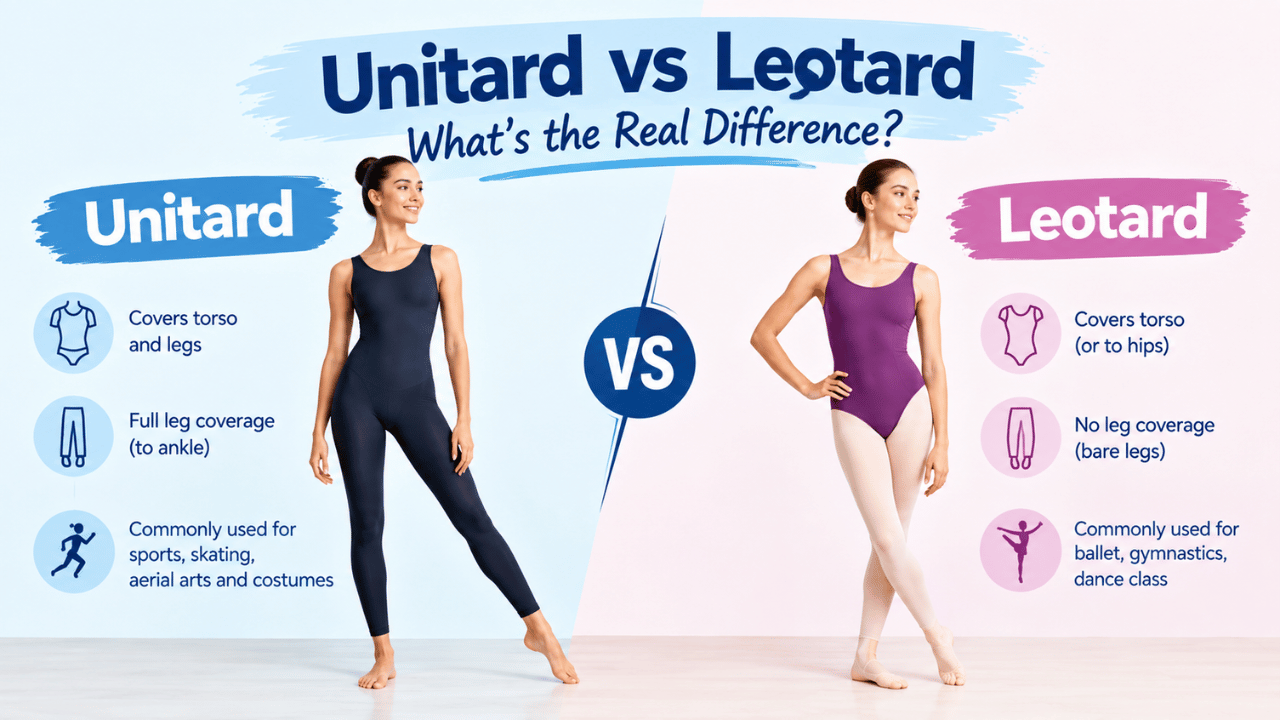
The unitard vs leotard argument comes down to one essential difference: how much of the leg the outfit truly covers. The leotard is a one-piece garment that covers the torso (or at least, goes down to the hips) while leaving the legs entirely bare. A unitard, however, goes all the way down, covering the torso and the legs in one continuous garment – often to the ankle!
This one difference ultimately makes or breaks the unitard vs leotard debate, and once you recognize it, telling one from the other in any shop, catalog, or costume store should be a walk in the park.
Unitard vs Leotard at a Glance
| Feature | Leotard | Unitard |
| Torso Coverage | Yes | Yes |
| Leg Coverage | None (bare legs) | Full length, typically to ankle |
| Common Pairing | Tights, leggings, shorts | Worn alone |
| Typical Uses | Ballet, gymnastics, dance class | Cycling, ice skating, costumes, aerial arts |
| Historical Origin | Named after Jules Léotard | Evolved as an extended version of the leotard |
A Quick History Lesson
But the unitard vs leotard debate is all the more fascinating once you discover where leotards got their name from. It’s called a leotard after Jules Léotard, 19th century French acrobat and trapeze artist, who introduced the practical one-piece, body-hugging garment into aerial performances so it would stay out of his way. Gradually, the leotard became an essential part in dance, gymnastics, and figure skating outfits with its close-fitting design and range of motion.
The unitard evolved later, as an extension of the same basic idea, covering not just the torso but also the lower torso (legs) in a single piece of material. The unitard was used as a natural extension of the cat suit/costume that arose in response to coverage needs (warmth, modesty, costume design) for various athletic and performance disciplines.
Also Read: Hussle vs Hustle | Girlie or Girly | Meet and Greet | Eventhough or Even Though
When Is a Leotard the Right Option?
For our last comparison of the unitard vs leotard, a leotard is actually the choice that you go with sometimes in only particular situations:
Ballet and dance classes. A leotard and tights are practically the uniform of traditional ballet training, since the combo lets teachers easily identify lines in the legs, foot placement, and positions for correct turnout, a must-have if you need to fix your form.
Gymnastics practice and competition. Several gymnasts – individually, artistic gymnastics has long been performed in leotards as a way to have judges (and coaches) more easily see visual factors like body lines and definition through the legs in competition.
Warmer climates or layered outfits. Because the leotard would leave the legs bare, it is usually more comfortable in warmer studios or when used with separate leggings, shorts, and/or tights that can be exchanged depending on the season or activity.
When Is the Better Option for a Unitard?
The other side of the coin: unitard vs leotard. A unitard seems to make more sense when full-leg coverage adds a practical or aesthetic benefit:
Costumes of ice skating and figure skaters. To alleviate that problem, many competitive skaters opt for unitards instead of a bodysuit underneath their skating dresses or as a standalone costume piece because the seamless full-length design creates a cleaner silhouette without visible seams at the tights/leotard interface.
Cycling and endurance sports. Because the aerodynamic (and potentially draft-dodging) design covers you from head to toe, less fabric creates drag and there is no gap between a top and bottom garment, cyclists often sport unitards-sometimes called skinsuits in this context.
Aerial arts and acrobatics. For this reason, performers on aerial silks, trapeze or acro-yoga often prefer to wear unitards rather than separate garments where the risk of shifting, riding up or falling off can occur during dynamic moves.
Costumes and theatrical performances. Costume designers adore unitards too because they can cover the entire form without a break, decorated in one piece if desired with color and texture from shoulders to ankles.
Best Use Cases in the Unitard vs Leotard Debate
| Activity | Recommended Garment |
| Ballet Class | Leotard + Tights |
| Artistic Gymnastics | Leotard |
| Figure Skating | Unitard or Leotard + Tights (varies by style) |
| Cycling | Unitard |
| Aerial Arts | Unitard |
| Theatrical Costuming | Unitard |
| Warm-Weather Dance Practice | Leotard |
Fabric and Fit Considerations
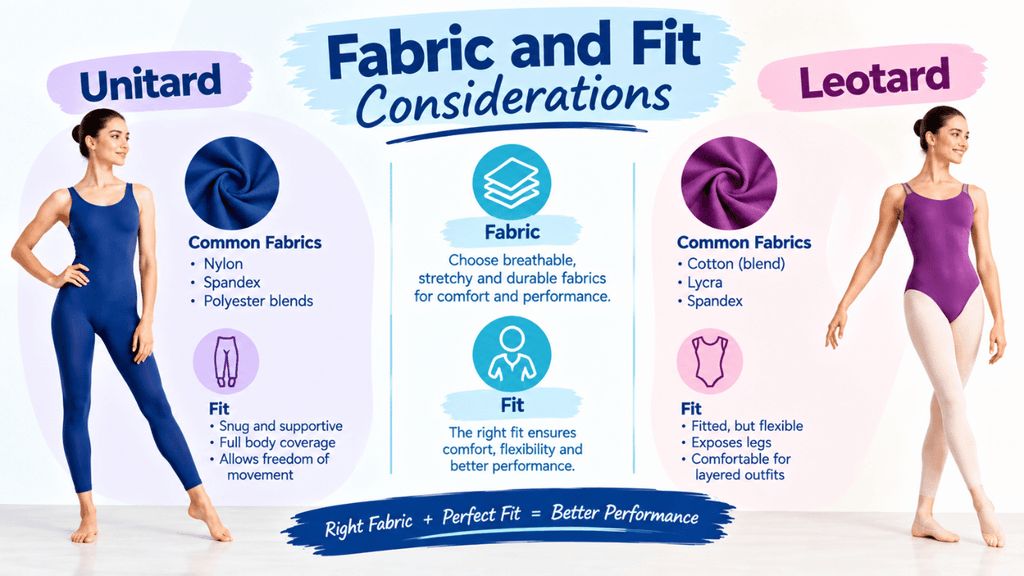
The textile for both unitard vs leotard are often made out of similar stretch materials (generally, a mixture of polyester with spandex or lycra) to take advantage of the fabric properties that provide four-way stretch, breathability, and durability during movement. Given that both garments are fitted, sizing is far more crucial than with looser clothing. An ill-fitting leotard may ride up too high at the hips, while an incorrectly-sized unitard can reach the knees and ankles on units that are either not adequately sized or do not have a matching leg length.
It will always be advisable to try different sizes when buying for either case or look at the brand’s precise measurement guide closely, since fit measures can vary greatly between manufacturers, a very different measure of size from one brand to another even within just one type.
Styling and Layering Differences
From a practical angle, the unitard vs leotard comparison continues with how each garment fits into an ensemble. Because leotards are naturally more layering-friendly, chances are, they’ll be worn with various tights, leggings, or shorts depending on the activity, weather, or style preferences. So, simply by swapping out what will go underneath the leotard or over it, a single one can now be useful in several different contexts.
In contrast, unitards serve more as a single piece state of being. Though some people layer shorts or a skirt over a unitard for modesty or aesthetic purposes, the piece itself is generally intended to act as an all-in-one bodysuit; one major advantage of this is eliminating any decision-making process as it pertains to choosing a separate bottom before practice or performance time.
Comfort and Practical Considerations
For everyday practice rather than performance, unitard vs leotard comes down to comfort. Other than the great amount of friction that can happen with touching fabric, some wearers feel that leotards do not constrain their movement as effectively as bare legs allow for a greater degree of air circulation. For others, the reason for preferring this garment is precisely because it combines leotard with tights in one piece and therefore avoids the possibility of the unsightly gap or rolling which can occur where a separate leotard meets separately-worn tights, especially during vigorous nutation high-movement, activities like tumbling or aerial work.
Bathroom breaks are, of course, another consideration that must be taken into account in any unitard vs leotard debate generally speaking and especially when it comes to younger dancers and gymnasts. A unitard is a one-piece garment covering the entire body, which makes it so that nature calls, you might have to take off everything while with a leotard and tights combo you can sometimes just pull down the tights.
Care and Maintenance Tips
Because, without going too far into the clothing care science area, both of these garments in our unitard vs leotard comparison are usually made from soft inter-linked movement based stretch textiles, how well you treat them has quite a lot to do with their longevity. Hand washing or gentle cycles in a mesh laundry bag are both good options for them, since the high-speed agitation sometimes used by machines can stretch fabric elasticity out quicker than standard wear and tear would do on its own.
When it comes to air drying vs. machine drying, the preference heavily leans toward letting swimwear and activewear air dry instead of allowing them to tumble dry, as excessive heat can break down the spandex or lycra material which is crucial for maintaining that signature stretch in these garments! As a unitard has much larger fabric surface area than a leotard, it can take significantly longer to air dry and this is an aspect worth considering if you need it quickly ready for a class or performance.
Which One Should You Choose?
At last, the real answer when it comes to choosing between a unitard or a leotard will result from your favourite activity, comfort preferences and dictates by your studio, team or performance director. Leotards are almost certainly the expected option if you are in any kind of formal ballet or gymnastics class and instructors need to really see your leg lines. So if you want some armor for cycling, some aerial arts, or something that needs a seamless full-length silhouette on a costume, the unitard is probably what you’re looking for.
Also Read: Eyeing or Eying | Chosing or Choosing | Tries or Trys | Seal vs Seel
Conclusion
The real difference of unitard vs leotard is fairly simple: how much leg you cover. A leotard is a closely-fitting one-piece with the legs open but usually accompanied by tights or leggings, therefore making it the traditional garment for ballet and gymnastics, whereas a unitard covers the body from shoulders to ankles in one piece and is best suited for cycling, skating, and costume-related work.
Knowing the difference between stretch and non-stretch clothes makes the shopping easier, whether you’re dressing for a dance studio, prepping to really get competing or making an outfit at home. No matter which side of the unitard vs leotard debate you fall on, as long as you choose based on your own activity and comfort needs, you’re likely to make the correct choice every time.
Frequently Asked Questions
1. What is the main difference between a unitard and a leotard?
Simply put, a leotard covers the torso and has the legs free; a unitard also covers the legs.
2. What is better for ballet, a Unitard or Leotard?
Ballet often calls for a leotard, as they are the kind of clothing that allows instructors to see leg lines and foot positioning.
3. Are unitards leotards for cyclists?
At the other end of the design spectrum, unitards or skinsuits for cycling are commonly used because their contiguous cut has the effect of lowering drag and breaking up any gaps between garments.
4. Can you wear tights under a unitard?
In general no, as unitards offer full leg coverage and tights are commonly worn under leotards.
5. Are unitards and leotards constructed of the same material?
Yes. Both typically use stretch fabrics like nylon-spandex or nylon-lycra blends.