
You know the kind of pairs of English words that sound similar but carry a wholly different meaning when usage has to be decided, and you have paused mid-sentence wondering whether to use roster or roaster. With elementary mistakes, when only one of two versions is right, it would be a matter of rejecting one, but here both words are obviously part of the English language and simply have very different functions. In this post, we will explain what it means for each word, why they are so easy to get confused with one another, and give a few tips to know which one to choose every time.
The Short Answer
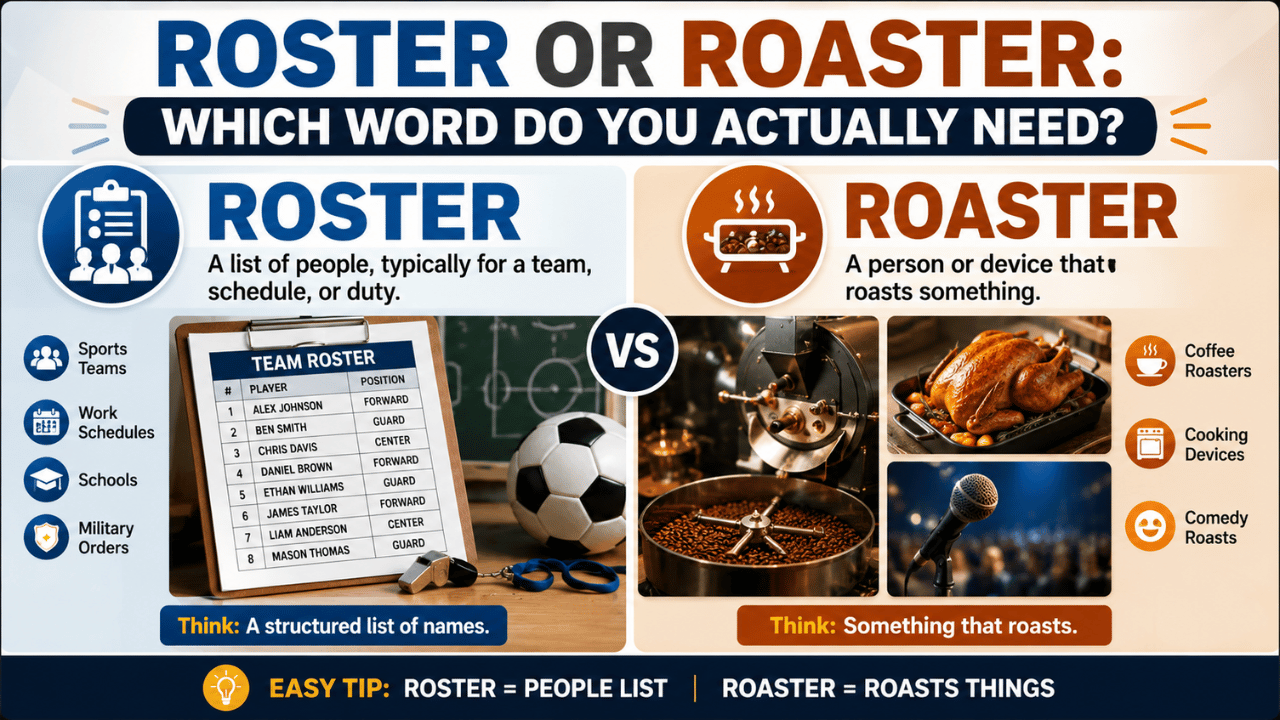
It’s not that one spelling is correct or incorrect, since both roster or roaster are valid English words. A “Roster” is a list of people (generally the members of a team) that have been assigned to a duty or scheduled to work, as for example the roster of a sports team or shift roster. On the other hand, a “roaster” can be defined as either someone or something that roasts, usually in reference to a coffee roaster, a cooking device, or, less formally, someone who roasted some other person (for comedy purposes, e.g., I am going to roast you with my friends for your birthday).
When you are choosing from roster or roaster (the options we will be looking at closely), the question is not which spelling is “correct”; it is which meaning is actually what you’re trying to say.
Breaking Down “Roster”
Roster is – roster noun: a list of names, as of personnel available for duty or passengers on an aircraft. It appears everywhere, in sports, workplace schedules, school rolls, military orders – anywhere a slate of people needs to be officially documented.
The word “roster” can be used in a few different ways; here are some sample sentences:
- “Drew made the final roster announcement for this season’s team.”
- Check shift assignment in a weekly roster
- “Found herself in the community event volunteer roster.
In both instances, roster refers to a structured listing of individuals; the fundamental definition of this term remains consistent regardless of which case it is placed in.
Breaking Down “Roaster”
The name “roaster” derives from the verb “to roast,” and either refers to a person or an object, tool, or appliance that is designed for roasting. You have had such an eye toward the rise of this word most often in cookery and coffee-related contexts, but it also has a more casual, cliché use distinctively in humor.
Sayings with correct usage of the word roaster:
- We also bought a massive new roaster for the turkey on Thanksgiving.
- Local coffee roaster gets beans from small farms.
- “On the show, he was known for his brutal, but funny roasts.”
Since a “roaster” is so directly linked with the roasting process, as in food, coffee beans, or the gaggle of witnesses who tore into someone’s reputation at a celebrity roast, its meaning tends to be much more precise and narrower than roster’s broader list-based definition.
How to remember when to use roster or roaster?
You probably might not know why the two words roster or roaster sound so similar when pronounced and are spelled almost identically; that is, why roster or roaster confusion happens. The words on either side of it are identical except for a single letter, an “e” in roster vs. an “a” in roaster, at the middle of otherwise matching structures. It’s an easy, understandable mistake to make due to the fact that English speakers tend to lean a bit heavily on sound—think about rapid-fire writing-so one will often be confused for another.
This type of confusion most often occurs in rapid informal writing, texting, short emails, and social media where there is less opportunity to proofread before clicking send.
A Side-by-Side Comparison
Perhaps if we put both words right next to one another, it will make their differences all the more apparent and easier to recall as you move forward with them.
| Word | Root Word | Meaning | Common Context |
| Roster | N/A (from Dutch “rooster,” meaning gridiron or list) | A list of names, typically for a team or schedule | Sports, workplaces, schools, military |
| Roaster | Roast | A person or device that roasts something | Cooking, coffee, informal comedy |
This table demonstrates quite brilliantly why the roster or roaster difference is not arbitrary at all, with the two words originating from completely different types of relationships — as opposed to having very similar appearances on the page.
Also Read: Comming or Coming | Planed or Planned | Bearly or Barely
Guessing the Etymology of the Word Roster
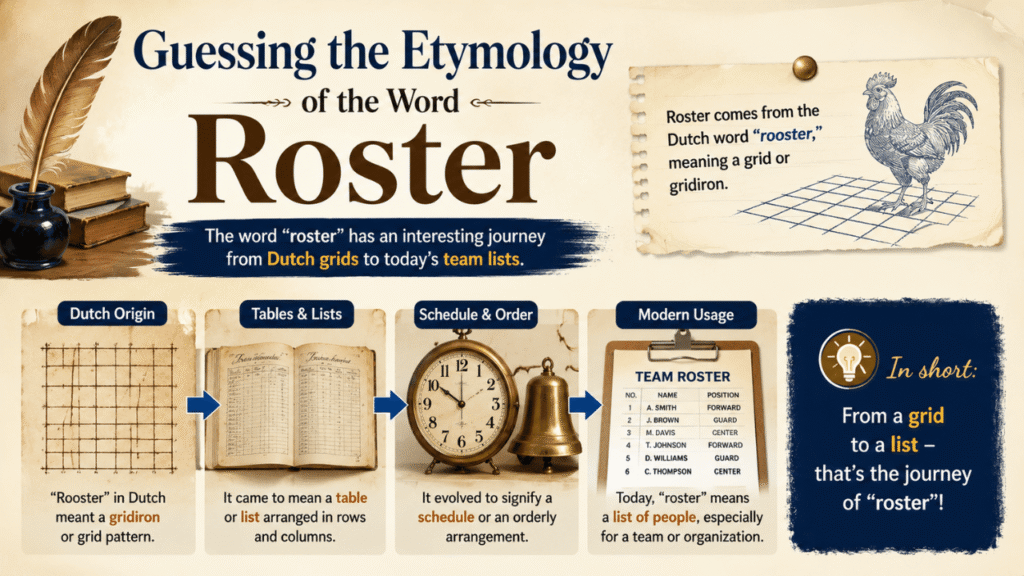
Interesting fact: the word “roster” has a truly distinctive lineage in contrast with the adjective of “roaster.” It comes from the Dutch word rooster, which originally meant a gridiron or grid pattern, then it became a table or list arranged in rows and columns (as thermometer) more like schedule or rather the definition of a grid. Eventually, this meaning evolved into the current lexicon sense of “roster,” which refers to a list of names, usually in terms of roster assignments (team) or scheduled work (from Irish: roth (s), ring; and stoíth–player).
Which also provides some insight as to why the word “roster” actually doesn’t have any etymological connection with either “roast” or “roaster,” no matter how similar the spellings and sounds. They just happened to take completely different functional pathways through the language, arriving at a strikingly similar spelling.
Where This Mistake Usually Occurs
The roster or roaster confusion tends to show itself in specific, predictable situations. A few common examples include:
- Sports coverage with team management (“Check the staff roaster” instead of “roster”)
- Emails Work place scheduling software (replace “roster” with “roaster” – please review this week’s)
- Blogs for cooking or product descriptions (“This coffee roster has three settings” is used correctly but often confused with “roster”)
- Small talk about comedy specials (“He did really well as a roaster on the show” correct skeletic but sometimes misspelled “Roster”)
Since the term “roster” is ubiquitous in professional and organizational settings, sports team line-up drafts, employee schedules and staffing plans, administrative documents, getting the spelling correct matters quite a lot in those contexts where mixing them up could actually create ambiguity about what a document refers to.
Tricks to Keep the Difference Straight
And if you still feel a little lost when it comes to roster or roaster, here are some ways to remember the difference:
- Connect “roster” to “list.” These two words rhyme, if you mentally train yourself that a roster is really only a list organized in rows.
- Connect “roaster” to “roast.” And because good old “roaster” is derived straight from the verb “to roast,” you could visualize a roasting pan or coffee roaster as an imagery device to anchor the correct spellings in your brain.
- Search for the “a.” Keeping in mind that there is an “a” in roast, a simple visual aid to help you catch it at first glance when distinguishing between roast and roaster.
- Consider the context first. Simply take a moment and say to yourself that, If the phrase is referring to a list of people, then use “among”; but if its talking about cooking or roasting something, just go with “a among”.
Before sending it off, re-read your sentence. The spell checker isn’t picking up these mistakes because they each contain correctly spelled words – so a quick proofread that carefully considers word choice will catch this type of mistake.
Why Autocorrect Won’t Always Catch This Mistake
This roster or roaster problem is tricky for autocorrect to fix, because both are real words (even if one of them isn’t the right word). Autocorrect tools aren’t typically based on correct word choice between two valid words with different definitions, but rather flagging misspelled words that don’t exist (which still has its issues – eg, focus vs focuss). So you could unwittingly drop a wrong word into the sentence without an automatic pop-up warning about it, which is especially important in writing that relates to professional or organizational documents.
Why Getting This Right Matters
I know this is a minutiae, but getting the difference between roster or roaster right will really help you to communicate more effectively in your writing in work such as sports management, workplace scheduling, or general communication with teams. Because context is king, using the incorrect one could create actual confusion for readers, given that they describe entirely disparate concepts-one a formal document and email in an official team communication setting where clarity matters most.
A simple double-check of which word fits your intent helps to maintain clarity in your writing and professionalism in a context where these words are frequently used, and a mistake could lead to an honest misunderstanding.
Also Read: Spell Calendar | Meaning of Jordan | What Does Ikkk Mean
Conclusion
This is not a question of correctness like many commonly confused word pairs, because roster or roaster are both real words that are spelled correctly for their particular meanings. Context is key: “roster” is a list of names, typically for a team or schedule, whereas “roaster,” in most instances, is the one performing (food that you put into an oven), coffee, or a roast master: the person who provides commentary while making light of someone’s shortcomings during a comedic roast. Remembering this little fact along with some very easy mnemonics will help you use the right word every time, without relying on autocorrect to catch a mistake that it probably wouldn’t even catch.
FAQs About Roster or Roaster
1. What does “roster” mean?
A roster is list of individuals organized either for a team, schedule or role.
2. What is the confusion between “roster” or “roaster”?
The only difference between them is one letter, and they look/sound almost identical.
3. Where does “roster” come from?
Originally a grid or gridiron, it comes from the Dutch “rooster.”
4. Will autocorrect catch the mistake?
But not always, as both words have correct spelling.
5. When is “roaster” used correctly?
In simple terms, it could mean one who roasts like a coffee roaster.