

Few names have the geographical, religious, and cultural resonance of Jordan. A name spanning an ancient river of the Middle East, perhaps, which has become one of today’s most recognizable English-speaking unisex names. If you are a parent considering it for your child, if you have a curious mind like the name Jordan, or simply interested in etymology, this guide covers the complete meaning of Jordan – what it stems from, what it means, and how it has come to be known as this name.
What Does Jordan Mean?
The original meaning of Jordan is literally “to flow down” or “descender”. It is derived from the Hebrew root word for “go down” or “descend, which is the Hebrew name Yarden, after the Jordan River. Ultimately, the name Jordan means to go downwards, which is appropriate as we see that it came from a word for an actual flowing river and not some abstract or invented term.
Other etymologies also render the meaning of Jordan poetically as “flowing waters” or (as has been interpreted, within a Hebraic context) “the descending one,” but all these names are derived ultimately from the same Hebrew root. Unlike Grace or Hope, it is not a name based on an abstract virtue or personality trait but one which comes from geography and movement.
The Jordan River: The Name Where It Started
In order to comprehend the meaning of Jordan, one should first understand the river itself. The Jordan River in the Middle East meanders from Mount Hermon down past the Sea of Galilee and into southern areas, into the Dead Sea along what is now modern-day Israel, Jordan, and the West Bank. Despite the significance of this river in religion and history, however, it is relatively small even compared to some other rivers in the world.
Its role as a river in the Hebrew bible is endemic. In the Book of Genesis, it is described as the rich plain where Lot decided to dwell, and also in the Book of Joshua, where God leads the Israelites across the Jordan River into what is now known as the Promised Land. This crossing is among the most symbolically loaded passages found in the Hebrew Bible, read as an intercession from wanderer to arrival, or struggle to fruition.
Jordan in the New Testament
The connection to baptism – and much of its later popularity as a forename- comes from the New Testament. In the Gospels of Matthew, Mark and Luke, John the Baptist baptises Jesus Christ in the Jordan River. This incident solidified the river’s portrayal in Christian lore as a site of spiritual cleansing, remorse and renewal.
This connection caused the Jordan River to become intimately related with the tradition of baptism itself, which in turn, became associated with the concept of renewal and spiritual purification.
How the River’s Name Became a Personal Name
The transition from “Jordan” as a toponymic use to “Jordan” as an initially individualized name was slow, and heavily mediated by medieval piety. People taking pilgrimages, hence a crusade, going to the Holy Land would sometimes bring back tiny vials of water from the Jordan River. This water was then used to baptize children back home in Europe, and as this custom grew, parents began naming their children cordially after this river Jordan, which held the important meaning with baptism.
And there is also a second important historical input to the name; it may have been further strengthened since the 6th-century Gothic historian Jordanes also had a Latin name close to that of the river. Some etymologists, though admitting that this influence is not the main reason for the continued use of the name in parts of medieval Europe, cite it as an additional one.
By the late Middle Ages, Jordan was a relatively widespread personal name and used in most of Christian Europe (though less popular for hundreds of years before a resurgence). This record traces the evolution of meaning of Jordan from a geographical concept to a personal name embraced by faith and culture.
Also Read: LYK Meaning | DLS Meaning | Hybb Meaning | What Does Ikkk Mean
Jordan as a Modern Given Name
The name had much revived usage from the 19th century, and a great blossoming in popularity during the second half of the twentieth century, especially in America. Not to mention, Jordan unofficially became a true unisex name; used for boys and girls alike- unlike so many other biblically rooted names, which have probably helped keep its steady popularity throughout the naming trends and generations.
And Jordan came alongside a larger aesthetic swing, one towards names that read both contemporary and antiquated: historical without being too traditional-sounding or stuffy. It also received an additional boost with the popularity of celebrity and fictitious bearers, all helping to normalize the name as a gender-neutral option for any parent.
Cultural and Symbolic Associations
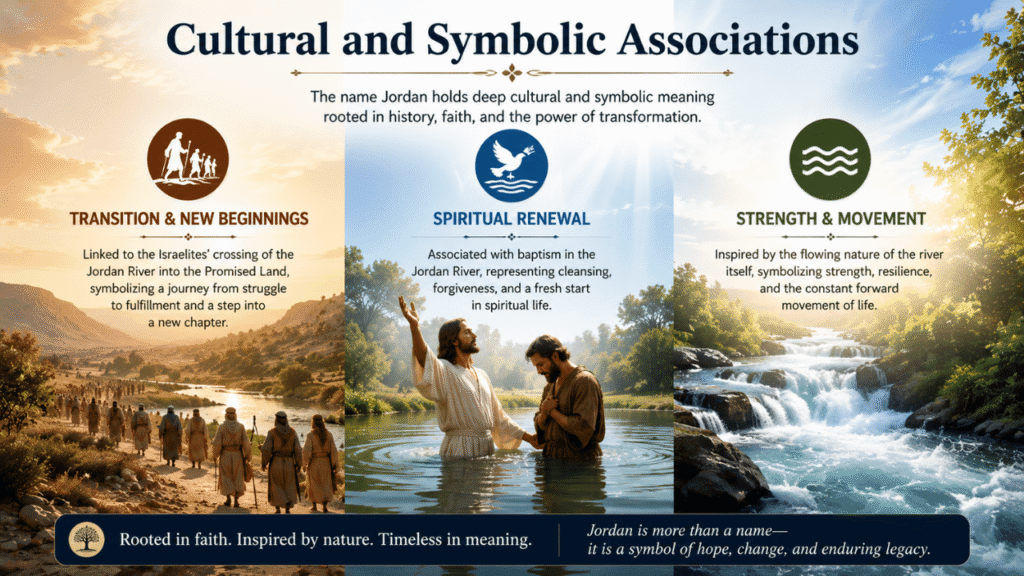
Thanks to its biblical roots, the meaning of Jordan has taken on larger symbolic associations throughout history, beyond just its literal translation. Due to its linking with the completion of Jordan River passage in the Book of Joshua and also baptism in the New Testament, the name is also often read as:
- Passage and new beginnings – related to the Israelites’ crossing into Canaan
- Spiritual rebirth – associated with Christian baptism
- Absolute strength and movement – based on the topographical definition of flowing or falling water
Not that parents deciding on the name today are thinking about ancient Hebrew word roots, but its long association with important transitions is one reason it has not fallen out of favor and remained popular among religious and secular families alike.
Variations of the Name Jordan
Many names with such a long history have various forms based on language and culture, and Jordan is no exception. These are the most common variants of the name is as:
| Language/Region | Variant Form |
| French | Jourdain |
| Italian | Giordano |
| Portuguese | Jordão |
| Dutch | Jordaan |
| Romanian | Iordan |
| Arabic | Urdunn |
| Spanish/Hungarian | Jordán |
| Modern English spellings | Jordyn, Jordin, Jorden, Jourdan |
All of these variations reveal how far the name traveled from its Hebrew original form while still maintaining that essential connection to the river and meaning of jordan, with adaptations for phonetics and spelling conventions in different languages.
Jordan as a Country Name
Therefore, it is prudent to briefly distinguish the name Jordan itself from the present-day country of that very name. The Hashemite Kingdom of Jordan, also located in the Middle East, derives its name directly from the Jordan River, which demarcates part of the country’s western border. Thus, the name for each flows from a common root centered on the river itself, but it is not a clear case of one being derived directly from the other.
Why the Name Jordan Has Stayed Popular
Here are a few reasons that may explain why Jordan has retained its allure:
- The unisex versatility, few names cross sexes as smoothly.
- That it is short and clean, sounds really easy to pronounce and spell across many languages.
- The weight of history: few contemporary titles have this much biblical and geographic lineage.
- Its link to famous support figures in sports, entertainment, and pop culture who maintained the name’s presence in popular culture over decades.
It is a balance of these elements that has kept Jordan from becoming dated the way so many trend-driven names inevitably do.
Also Read: Tmrw Meaning | Sped Meaning | Sober Meaning | Huzz Meaning
Conclusion
The meaning of Jordan is to flow down or descender, and its origin is one of the great rivers in Judaism and Christianity. Spread via the physical movement of water and later adopted as a personal name amid the Crusades, it is one of a handful of unisex names in English-speaking countries; Jordan has had an unusually rich history for something which, on its surface, just means “flowing down.” Whether you are attracted to it because of its sound, its history, or the symbolism behind it, it is a name with much more than most people will know.
FAQs About Jordan Meaning
1. What does the name Jordan mean?
The name Jordan is derived from the Hebrew word that means “to flow down” or “descender,” rooted in the Hebrew verb yarad, “to descend.”
2. Is Jordan a biblical name?
Yes. Jordan refers to the Jordan River that is mentioned multiple times in the Bible, most notably linked to the Israelites as they crossed into land promised to them by God (after escaping slavery) and where Jesus was baptized.
3. What does Jordan symbolize?
It highlights the biblical and geographical importance of that river in history, as well capturing the sense of new beginnings, spiritual renewal, transition, strength and action inherent in the use of name Jordan.
4. Is Jordan a unisex name?
Yes. Jordan is commonly utilized as a unisex name to describe either a boy or girl, especially in English-speaking nations.
5. Where does the name Jordan come from?
Jordan came from the Hebrew name Yarden, which was the ancient name of the Jordan River. It ultimately derives from the Hebrew root yarad, meaning “to descend” or “go down.”