
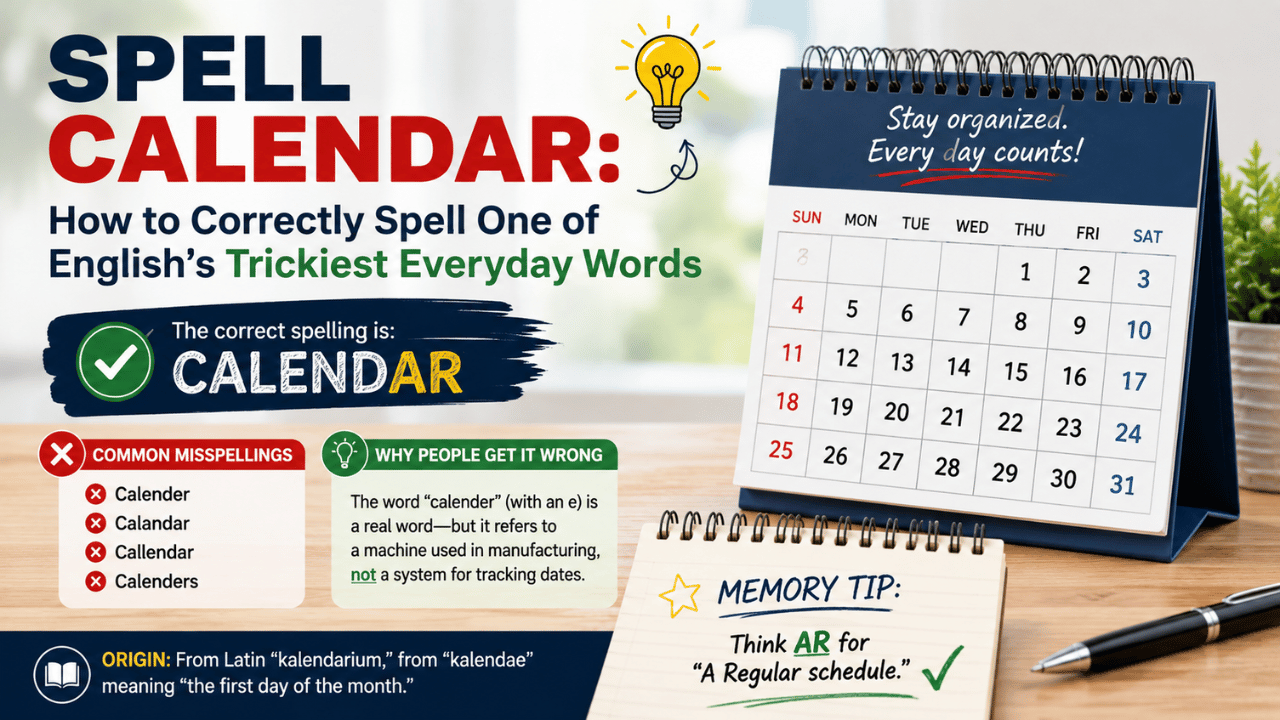
“Calendar” is one word that trips people up quite a bit. One of the most frequently used words in the English language (to the extent that we see it on our phones, bullet journals, and wall displays around nearly every home and office), yet surprisingly often misspelled. If you have ever found yourself mid-sentence wondering whether it’s calendar or calender near the end, you are far from alone. In this post, we will review how to spell it correctly, take a look at why so many people are getting it wrong, and share several memory tricks to ensure that you’ll be able to spell calendar right going forward.
The Correct Spelling
Let’s get the most important bit out of the way first. The correct spelling is C-A-L-E-N-D-A-R. Take note that the word ends with -ar but not -er. This is where most people go awry, as in speech the “er” ending is almost indistinguishable, and it can lead to an incorrect guess being made based purely on phonetics rather than a clear memory of what the word looks like.
When you are attempting to spell calendar correctly, the best rule of thumb is to actively remember that final “ar” ending as this one characteristic accounts for nearly all spelling errors made with this word.
Why This Word Is So Commonly Misspelled
The reason for the well-known misspelling calender may come down to a hypnotic combination of pronunciation habits and English’s crazy spelling rules. In natural speech, the end of the word gets a little blurry and sounds almost identical regardless of whether it ends with “-ar” or “-er”. With a rich collection of common English words ending in “-er” like “teacher,” “computer,” or calendar’s close cousin, the manufacturing-use only calender (a valid word but no relation), it is not surprising so many writers instinctively go with the comfort food.
This type of confusion is really common with English words that don’t follow a completely predictable spelling pattern. And so even some strong writers sometimes doubt themselves when it comes to spelling calendar, particularly if they are typing quickly (or writing by hand), and have no autocorrect function to rescue them.
The Most Common Misspellings
Looking directly at the common misspellings of calendar can help remind you of the correct version.
| Incorrect Spelling | Why It Happens |
| Calender | Confuses the word with an unrelated manufacturing term |
| Calandar | Swaps the first vowel pattern incorrectly |
| Callendar | Adds an unnecessary extra letter |
| Calenders | Correct plural form, but often misused for the singular |
All of these common mistakes laid out next to each other make it much easier to see precisely where the confusion tends to lie, which is often the first step towards permanently fixing the mistake.
Also Read: DLS Meaning | Hybb Meaning | Huzz Meaning | Tmrw Meaning
Another Word You Already Know: “Calender”
One of the most interesting reasons that people often fail to spell calendar correctly was because “calender,” with an e, is a real word in English right up until you read how it is defined. A calender is a machine used in the manufacturing of paper, textiles, and plastics by applying pressure to materials to obtain a smooth or glazed surface by passing it through a succession of heavy rollers.
Given how similar the word looks and sounds, it is unsurprising that so many people mistakenly “borrow” its spelling when they mean to spell calendar in the everyday sense of a system for organizing days, weeks, and months. Remind yourself of the distinction that calender is for industrial equipment, while a calendar can be used for tracking dates moving forward.
Where Does The Word ‘Calendar’ Come From
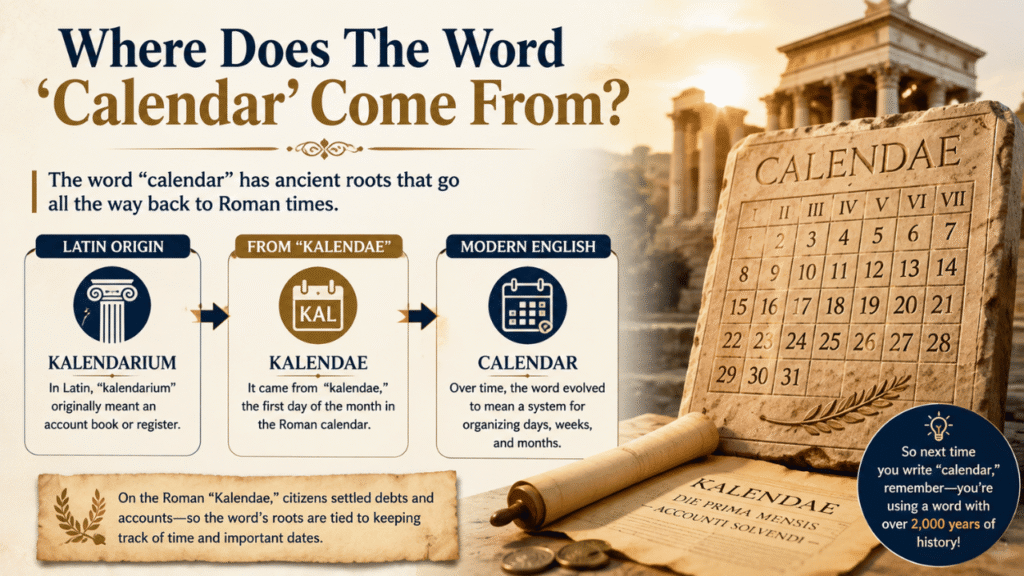
Knowing the etymology of a word often facilitates memorizing its orthography, and the story of how we spell calendar is, in fact, quite interesting. The etymology of the word comes from Latin “kalendarium,” which originally described an account book or register and then directly from “kalendae,” the first day of the month in the ancient Roman calendar. On this day, Roman citizens would settle debts and accounts; thus the time concept transformed into what we understand as a calendar: a way of tracking dates.
Well, that -arium of the original Latin root is an important clue as to why the modern English version keeps that -ar ending instead of morphing into -er. The next time you see calendar and feel confused about how to spell the ending, this Latin connection can be a handy anchor in your mind.
Memory Hacks to Remember How to Spell Calendar
If you find this word repeatedly troublesome, some mnemonics will cement its right spelling in your brain forever.
Note that you will concentrate on AR for “A Regular schedule.” This can help you build up the correct end letters to “-ar” by associating it with something happening regularly or scheduled.
Break it into syllables. Spell it out loud – repeat the word verbally as if being pronounced slowly, such as “cal-en-dar”; this will help train your brain to write the correct set of letters.
Remember the “calender” machine. And remember, “calender” with an e refers to something completely different – an industrial rolling machine –, and it can help avoid asking your neighbor for a loan of that spelling.
Practice writing it by hand. The flexibility of spelling allows a child to write out the misspelled version right next to it so they can know the correct spelling by physically writing it out several times, which sticks better than seeing a written word countless times.
Use it in a sentence. When encountering the correct spelling of a word, write it down and repeat it in context as actively as possible instead of doing memorization exercises or writing the sentence with that particular word down.
Words That Confuse Each Other in Printing Rules
This principle is not a special case, and explains why he had trouble spelling calendar as well. Many other related English words fall into the same trap, with an unattended vowel sound at the end and a variety of spelling options.
In fact, there are quite a few standard words that still end in -ar instead of -er, such as “grammar,” “similar,” and “popular.” If you know everyone commits this error, it should be more logical to make sense of the spelling of calendar because it corresponds with a lot of common English words that have the same less-well-known ending.
What Autocorrect Made Us Spell Calendar
To be fair to the new generation, modern technology has made it less likely that anyone will need to know how to spell calendar off the top of their head very often. For spell-checks on most word processors, for literally any smartphone to use, or even for most digital calendars, a thing that has entered the lexicon across a lot of spheres at this point– it corrects as fast as you write it incorrectly, making it probably easier than it’s ever been to use correctly anyway without perhaps knowing its spelling all that intimately.
However, if you are entirely dependent on auto-correct, there is some component that works to fight actual learning, as students/professionals have a writing-on-pen-and-paper model or filling up scratchy forms, not always being able to write by hand without making a mistake like a spell-check model. Knowing how to spell calendar without help from a computer is still a truly useful skill, especially in more formal and/or academic writing contexts.
Why Correct Spelling Still Matters
We are in the age of instant spell-check; should it matter to write calendar correctly without any help? In reality, as much as correct spelling may seem irrelevant, it still has some serious heft within professional communication and academic writing, any place where paying attention to the nuances shows credibility. A misspelled word in a CV, business email, or legal text creates the wrong impression of laziness; even if it’s unclear which of stative with “calendar” and calender is introduced, the right one.
Spelling Calendar: In the long run, taking time to actually learn to spell calendar (as opposed to having it auto-corrected with zero human input) builds general writing confidence and helps prevent nasty things from slipping through in high-pressure scenarios where spell-check is not an option.
Also Read: Sped Meaning | Sober Meaning | Sunday Blessings and Prayers
Conclusion
Although this may be a minor detail, it is an interesting illustration of how English spelling often eschews phonetic, logical reasoning by learning to always spell calendar correctly. The confusing similarity to the completely unrelated word calender, coupled with its more obscure -ar ending, makes this a term that many writers trip over. In fact, with some practice, a few mnemonics here and there, and knowing fairly well where the word really comes from, spelling calendar correctly is no longer something that you have to second-guess each time you sit down to write.
Frequently Asked Questions
1. How do you spell calendar?
The correct spelling is C-A-L-E-N-D-A-R.
2. Why is calendar often misspelled?
The –ar and –er endings sound alike, creating potential confusion with calender.
3. Is “calender” ever correct?
Yes. Calender is an industrial machine used to manufacture a material that comes with any type of finishing or high-smooth surface.
4. What is the etymology of calendar?
It originates from the Latin “kalendarium,” which means record book.
5. Is the auto-spell option enough to use for learning the spellings?
No, knowing the accurate spelling is still important for formal and handwritten writing.